
10 DIY Dog Wheelchair Ideas That Get Dogs Moving Again (2026)

Watching your dog struggle to stand is one of the hardest things a pet parent can go through. When those back legs stop cooperating, a DIY dog wheelchair can give your pup their freedom back — and you don’t need to spend hundreds of dollars on a commercial cart. With affordable materials and a free afternoon, you can build a sturdy, comfortable support cart at home.
Check with your vet first to make sure a wheelchair suits your dog’s condition. Then pick one of these 10 budget-friendly builds. Each follows the “two-finger” fitting rule: you should be able to slide two fingers between any strap and your dog’s body.
Table of Contents
- 1. PVC Pipe Frame Cart (Under $30)
- 2. Aluminum Tubing All-Terrain Cart
- 3. Kids’ Bicycle Wheel Upcycle
- 4. Wooden Dowel Frame Cart
- 5. Padded Fleece Sling Comfort Cart
- 6. Indoor Practice-Track Cart Setup
- 7. Quad-Wheel Full-Support Cart
- 8. Treat-Reward Training Cart
- 9. Night-Visibility LED Cart
- 10. Precision-Measured Custom Cart
- Frequently Asked Questions
1. PVC Pipe Frame Cart (Under $30)

This classic entry-level build needs about 36 inches of 3/4-inch PVC pipe, six elbow and T-joint connectors, two 4-inch rear wheels, one small front caster, and two nylon straps. Cut the pipe into a rectangular base, dry-fit everything, then cement the joints.
Mount the rear wheels slightly behind the hip line so the front legs still carry some weight. Line the sling with fleece and sand every cut edge smooth.
Helpful pick: UV-resistant zip ties — anchor the harness straps to the frame; they hold tight and snip off easily when you adjust the fit.
2. Aluminum Tubing All-Terrain Cart

For dogs that love trails or big yards, aluminum square tubing beats PVC for strength without much weight. Build a rectangular base with a curved rear arch, and use 6-inch rubber wheels that roll over grass and gravel smoothly.
Set the frame height so your dog’s spine stays level — a tilted cart strains the shoulders and tires them out fast. Deburr every drilled hole so no metal edge nicks skin.
Helpful pick: LSK L brackets — rock-solid frame joints without welding, and the cart still disassembles for travel.
3. Kids’ Bicycle Wheel Upcycle

An outgrown kids’ bike gives you correctly sized wheels and strong frame tubing for free. Strip the seat and pedals, flip the frame so the handlebar becomes the rear support bar, and attach two nylon webbing straps across it.
Position the straps behind the front legs — never across the belly — with the rear legs hanging free. Pneumatic tires roll quietly, which helps dogs that spook at rattling carts.
Helpful pick: Hotop hardware set — a full assortment of bolts, nuts, and screws makes mounting axles and strap brackets far easier.
4. Wooden Dowel Frame Cart

For small dogs, a wooden dowel frame is surprisingly sturdy and looks nicer than plastic pipe. Use 1-inch hardwood dowels joined with glue and screws, plus a small plywood platform under the saddle harness and four casters for maneuverability.
Seal the wood with a pet-safe finish so it wipes clean. Dry-assemble first and check the fit against your dog before gluing. Keep cart weight under 15% of your dog’s body weight.
Helpful pick: ONUPGO hardwood dowels — straight, smooth, and pre-sanded, so you skip the worst of the sanding and get right to building.
5. Padded Fleece Sling Comfort Cart

The top reason homemade carts get abandoned is raw spots where the harness rubs. Whatever frame you choose, wrap the sling in soft fleece with all seams facing outward, folding it over the strap edges so nothing bunches.
The sling should sit behind the ribcage, never on the spine. After each walk, check for pink spots — redness means loosen or add padding. Make two slings so a clean one is always ready.
Helpful pick: YourFleece fleece fabric — soft, washable, and breathable, it makes the difference between a cart your dog tolerates and one they enjoy.
6. Indoor Practice-Track Cart Setup

Most dogs need a few days to trust new wheels, and slick hardwood is the worst classroom. Low-pile interlocking carpet tiles give wheels gentle grip and protect floors while your dog learns to steer.
Start with five-minute sessions on a loose leash and end before they tire. Once they trot confidently indoors, move to the driveway, then the sidewalk.
Helpful pick: Orgthin carpet tiles — peel-and-stick, easy to cut around doorways, and they lift right back up when training is done.
7. Quad-Wheel Full-Support Cart

Rear-support carts assume strong front legs, but seniors often need help all around. A quad-wheel cart adds a front support frame with two swivel casters. Weight spreads across four wheels while the feet still touch the ground for gentle exercise.
Keep the front frame height adjustable so the legs bear more weight as strength returns. Pad every contact point twice over — your dog can’t tell you something is pinching.
Helpful pick: PetFusion orthopedic dog bed — a supportive place to rest between sessions helps tired muscles recover and gives sore joints a break.
8. Treat-Reward Training Cart

Training your dog to love the cart is half the project. Reward every step toward it, every calm second in the harness, and every few steps of rolling. Keep early sessions to five minutes and always end on a win.
Never force a scared dog into the frame. Let them eat meals next to it for a few days first. Most dogs go from suspicious to zooming within two weeks of positive training.
Helpful pick: KONG Classic — stuff it with peanut butter and let your dog work on it while standing in the cart; it builds positive associations fast.
9. Night-Visibility LED Cart

Dogs in wheelchairs ride low, making them nearly invisible at dusk. Run adhesive LED strips along both frame sides and the rear arch, powered by a small USB battery pack. The glow outlines the cart so everyone sees it coming.
Choose warm white or amber — flashing colors startle other dogs. Zip-tie wiring every few inches so nothing dangles near the wheels, and charge the pack after every walk.
Helpful pick: UMICKOO LED strip lights — flexible, adhesive-backed, and USB-powered, they bend right around frame corners without tools.
10. Precision-Measured Custom Cart
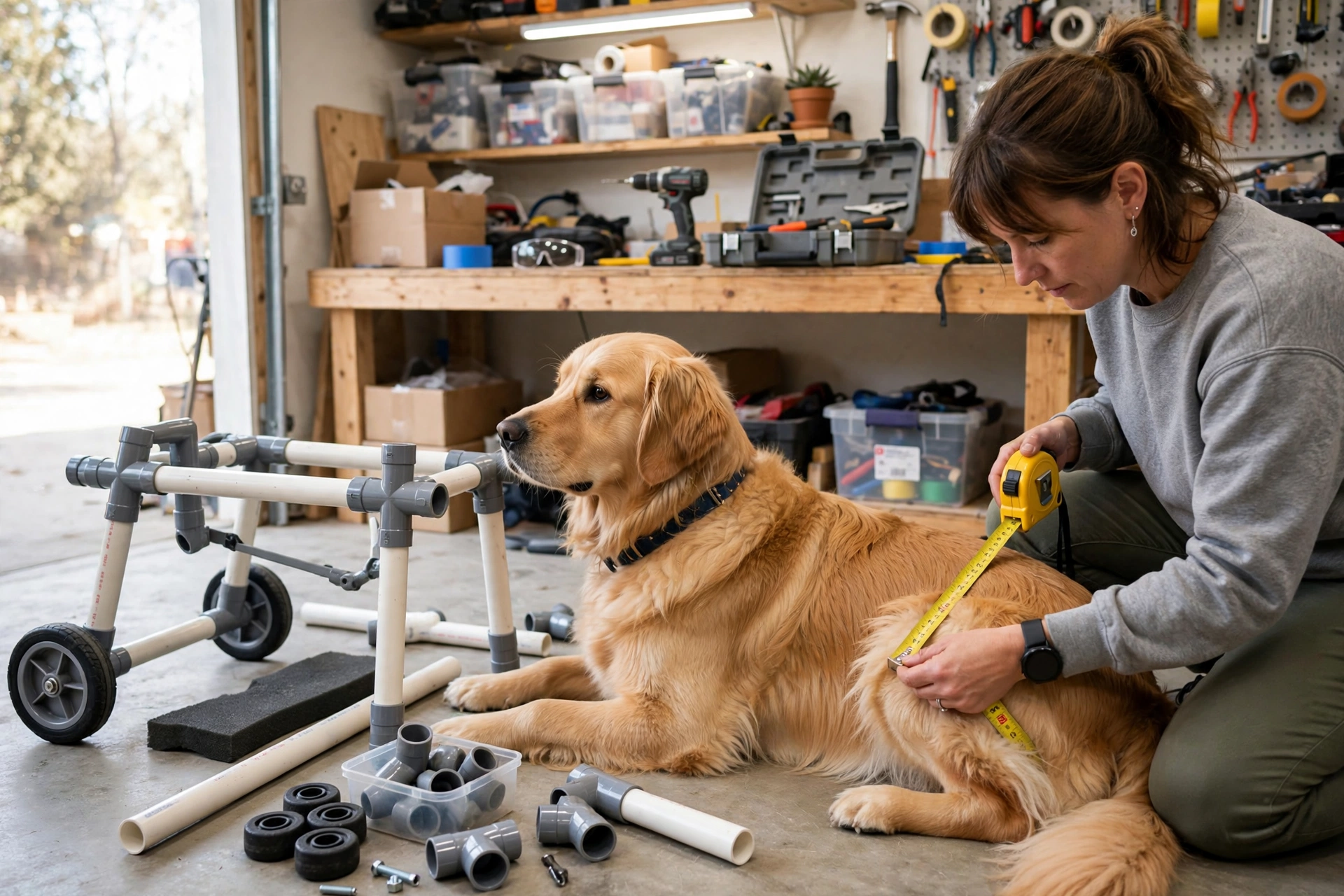
The best DIY dog wheelchair is the one that fits. Before buying parts, measure three times: hip width, leg length from hip to paw, and body length from shoulder to hip. Add two inches of width clearance and set the axle just behind the hip joint.
Write every measurement on one card and keep it with your tools. Recheck the fit weekly for the first month — dogs gain or lose muscle fast once they’re rolling.
Helpful pick: BUSHIBU measuring tape — soft and flexible, it wraps around your dog’s body without poking or startling them.
Keep Reading
- 7 DIY Dog Bunk Bed Ideas for Small Spaces
- 15 Indoor Dog Park Ideas for Rainy Days (2026)
- 10 Dog Hotel Ideas That Feel Like a Vacation (2026)
- 10 Dog Photo Ideas You’ll Want to Frame (2026)
- 10 Dog Painting Ideas for Pet Lovers (2026)
Frequently Asked Questions
How do I know if my dog needs a wheelchair?
If your dog drags their back legs, can’t stand on slippery floors, or tires after a few steps, ask your vet for an assessment — the right design depends on the diagnosis.
How much does a DIY dog wheelchair cost to build?
Most builds cost between $25 and $80 in materials. A basic PVC frame cart is cheapest, while aluminum tubing and quality wheels push the price up — still a fraction of commercial carts, which often run $300 to $600.
How long should my dog stay in the wheelchair each day?
Start with 10 to 15 minutes, two or three times a day, building up as stamina improves. Never leave a dog unattended in a cart, and remove the harness for rest periods.
Can a dog pee and poop while in a wheelchair?
Yes — a properly fitted rear-support cart leaves the back end open, so most dogs relieve themselves normally. If your design uses a full belly sling, cut a relief opening or switch to a two-strap saddle style.
Will my dog’s legs get weaker from using a wheelchair?
Not if the cart fits correctly — it lets the legs move naturally and bear partial weight, which supports muscle tone. Dogs that drag themselves lose muscle faster and risk skin injuries.
As an Amazon Associate, PetPostHub earns from qualifying purchases.


