7 DIY Dog Steps for Bed You Can Build This Weekend

When your dog starts hesitating at the edge of the bed, you feel it in your chest. That little pause, the front paws up, the look back at you — it means climbing has become work instead of joy. DIY dog steps solve this problem for a fraction of the cost of store-bought pet stairs, and you can build them to match your bedroom exactly. Below are 7 fully original builds, from a classic upholstered staircase to a senior-friendly ramp, each with a materials list and step-by-step instructions.
Table of Contents
- 1. Classic Plywood Upholstered Stairs
- 2. No-Sew Fleece-Wrapped Foam Blocks
- 3. Pallet Wood Rustic Steps
- 4. Storage Crate Combo Stairs
- 5. Cardboard Box Tiny-Dog Stairs
- 6. Low Incline Training Ramp
- 7. Landing Cushion Convertible Set
- Safety Tips for Every Build
- FAQ
1. Classic Plywood Upholstered Stairs
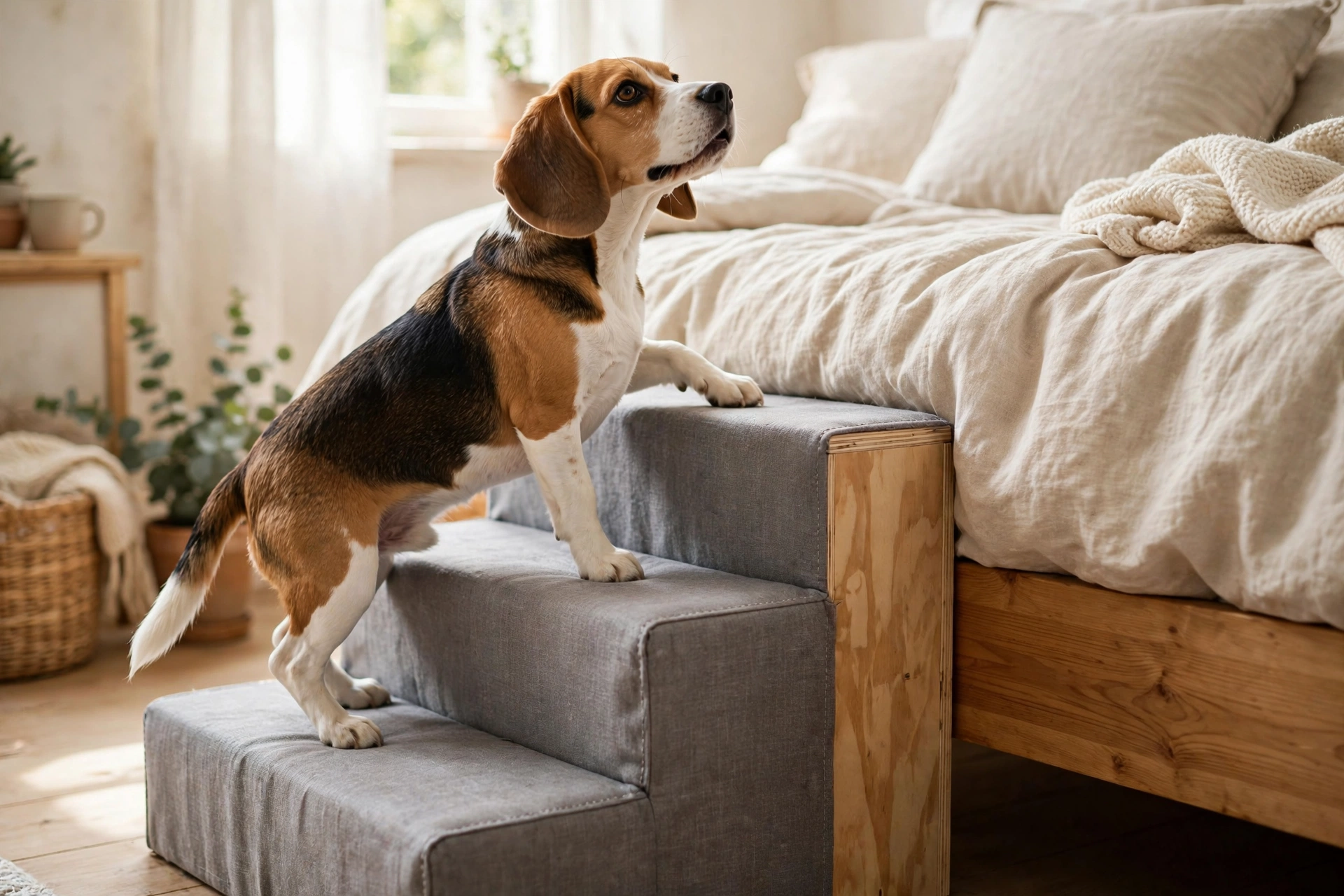
This is the workhorse build: three sturdy plywood steps wrapped in soft upholstery fabric. It looks like furniture, holds large breeds, and survives daily use for years.
Materials: ¾-inch plywood cut into three graduated step pieces, 2-inch high-density foam pads, upholstery fabric (about 2 yards), staple gun with ½-inch staples, wood screws, sandpaper.
Instructions:
- Cut the plywood into three step platforms, each roughly 18 inches wide, with the top step highest and the bottom step widest for stability.
- Sand every edge smooth so fabric does not snag and paws stay safe.
- Cut foam pads to match each step top and attach with wood screws driven from underneath, or secure with spray adhesive.
- Cut fabric 3 inches larger than each step on all sides. Lay the fabric face-down, place the foam, then the plywood on top.
- Pull the fabric taut and staple underneath, folding corners like a gift. Start with the long sides, then fold and staple the corners.
- Stack the steps from tallest to shortest and fasten them together with wood screws from inside the frame so nothing shifts.
Helpful pick: Surebonder Mini Glue Gun — handy for tacking fabric trims and non-slip pads to each step.
2. No-Sew Fleece-Wrapped Foam Blocks
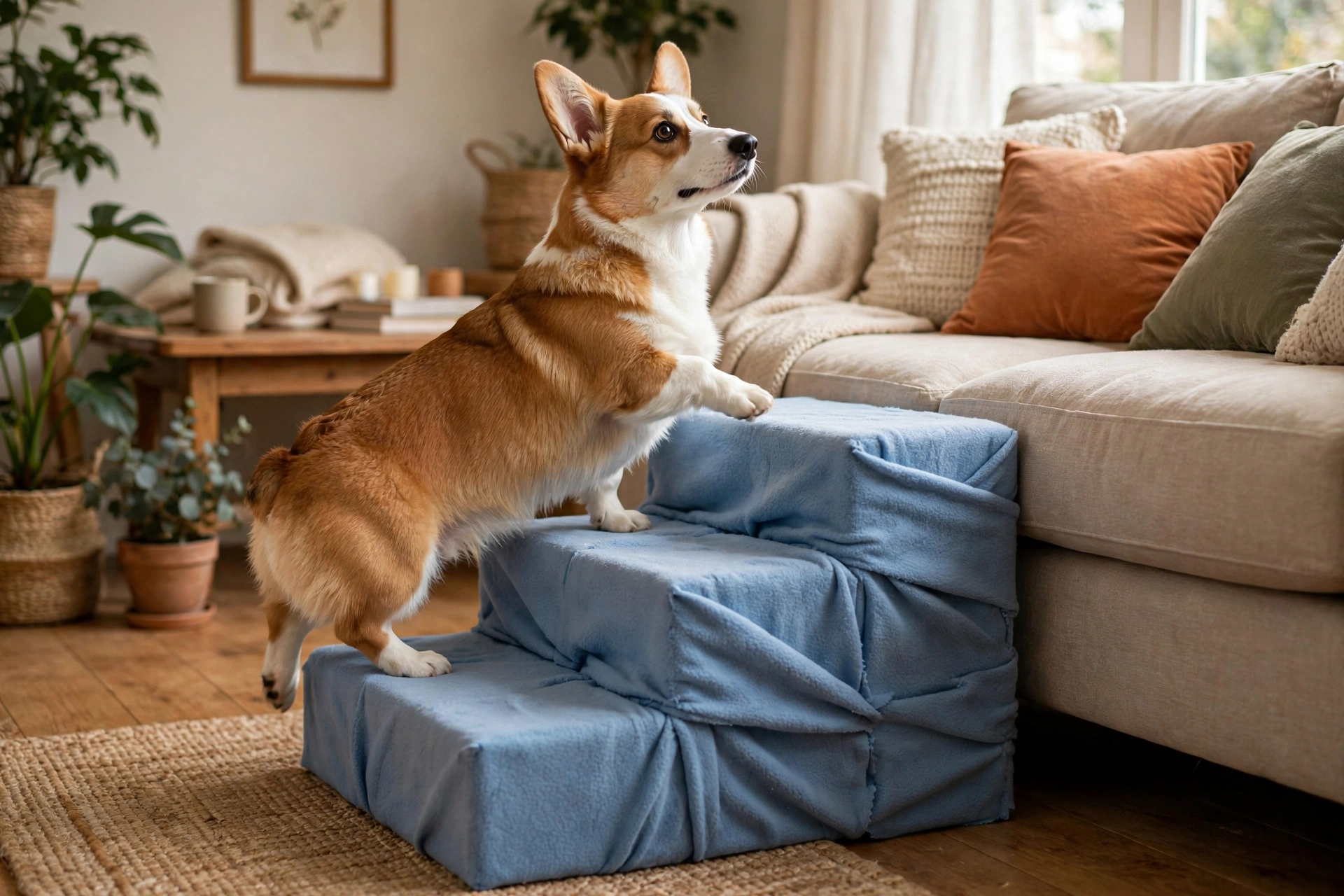
No tools, no sawdust, no sore back. Stack graduated foam blocks, wrap each in fleece, and you have soft stairs that small dogs and puppies adore.
Materials: Three high-density foam blocks in descending sizes (about 12″W × 8″H × 16″D each), 2 yards of polar fleece fabric, fabric scissors, non-slip shelf liner cut for the base.
Instructions:
- Arrange the blocks from tallest to shortest against the bed to confirm the height works before you wrap anything.
- Cut a fleece panel for each block, leaving 4 inches of extra fabric on every edge.
- Wrap each block like a gift and tie the excess fabric in a tight knot underneath, or secure with safety pins hidden on the underside.
- Stack the wrapped blocks and place a strip of non-slip shelf liner under the base so the stairs cannot slide on hard floors.
Helpful pick: EOVEA Polar Fleece Fabric — soft, stretchy, and washable enough to survive muddy paws.
3. Pallet Wood Rustic Steps

For farmhouse-style bedrooms, pallet wood steps are unbeatable. The rough-hewn texture doubles as paw traction, and the build costs almost nothing if you source free pallets.
Materials: 2–3 clean pallets, wood screws, wood glue, sandpaper (80 then 120 grit), a saw for cutting planks, measuring tape.
Instructions:
- Disassemble the pallets carefully and discard any cracked or splintered planks.
- Cut planks into stair risers and treads sized for three steps, each tread about 10 inches deep.
- Build two side frames shaped like staircases and screw the treads between them.
- Sand all surfaces until no splinters remain, especially the front edges where paws land.
- Secure the finished steps against the bed with an anti-tip bracket so the unit cannot tip backward.
Helpful pick: BLACK+DECKER Jigsaw — makes quick work of cutting pallet planks to matching lengths.
4. Storage Crate Combo Stairs
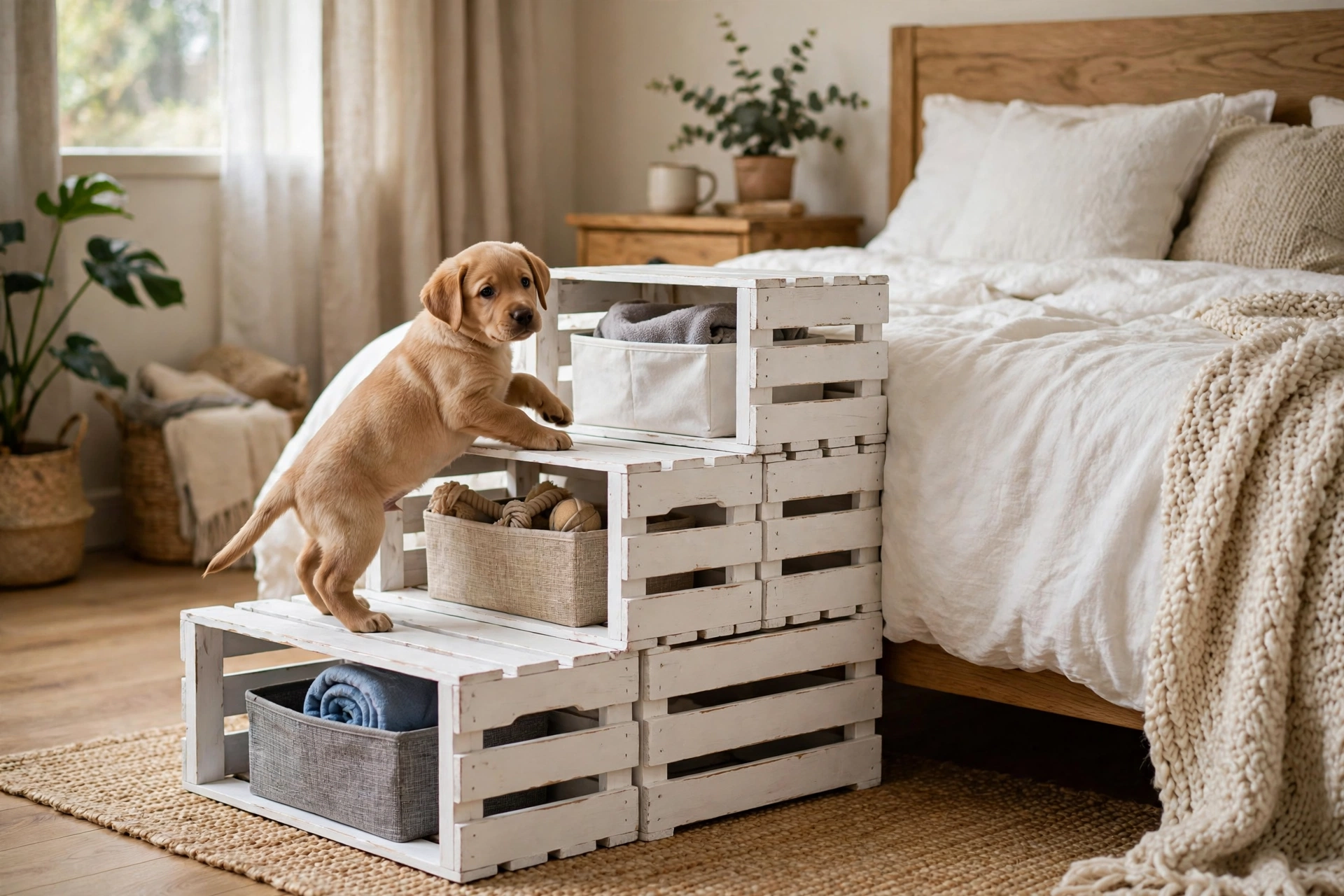
Three wooden crates stacked as stairs give your dog a climb and give you hidden storage for leashes, toys, and treats in one build.
Materials: Three sturdy wooden crates (descending sizes work best), wood paint or stain, L-brackets, screws, sandpaper, small storage bins that fit inside.
Instructions:
- Sand each crate inside and out, then paint or stain to match your bedroom furniture.
- Position the crates as a staircase: the largest on the floor against the bed, the smallest on top as the landing step.
- Connect the crates with L-brackets and screws at every contact point so the stack behaves as one solid unit.
- Place the whole stack flush against the bed frame to prevent any gap where a paw could slip through.
Helpful pick: LSK L Brackets — locks stacked crates together so nervous dogs get a wobble-free climb.
5. Cardboard Box Tiny-Dog Stairs

Chihuahuas and teacup breeds do not need lumber-grade construction. Reinforced cardboard boxes wrapped in pretty paper make surprisingly durable little stairs.
Materials: Three sturdy moving boxes in graduating sizes, packing tape, decorative wrapping paper or contact paper, scissors, a small cushion for the top landing.
Instructions:
- Reinforce each box with a second layer of packing tape along every seam, and fill the boxes with crumpled newspaper for firmness.
- Tape the boxes shut and arrange them as a staircase, tallest nearest the bed.
- Tape the boxes to each other so they cannot separate underfoot.
- Wrap the entire stack in decorative paper so it blends with your room instead of looking like moving day.
- Top the landing step with a small cushion for a soft arrival.
Helpful pick: MidWest QuietTime Bolster Dog Bed — the perfect size to cap the top step of a tiny-dog staircase.
6. Low Incline Training Ramp
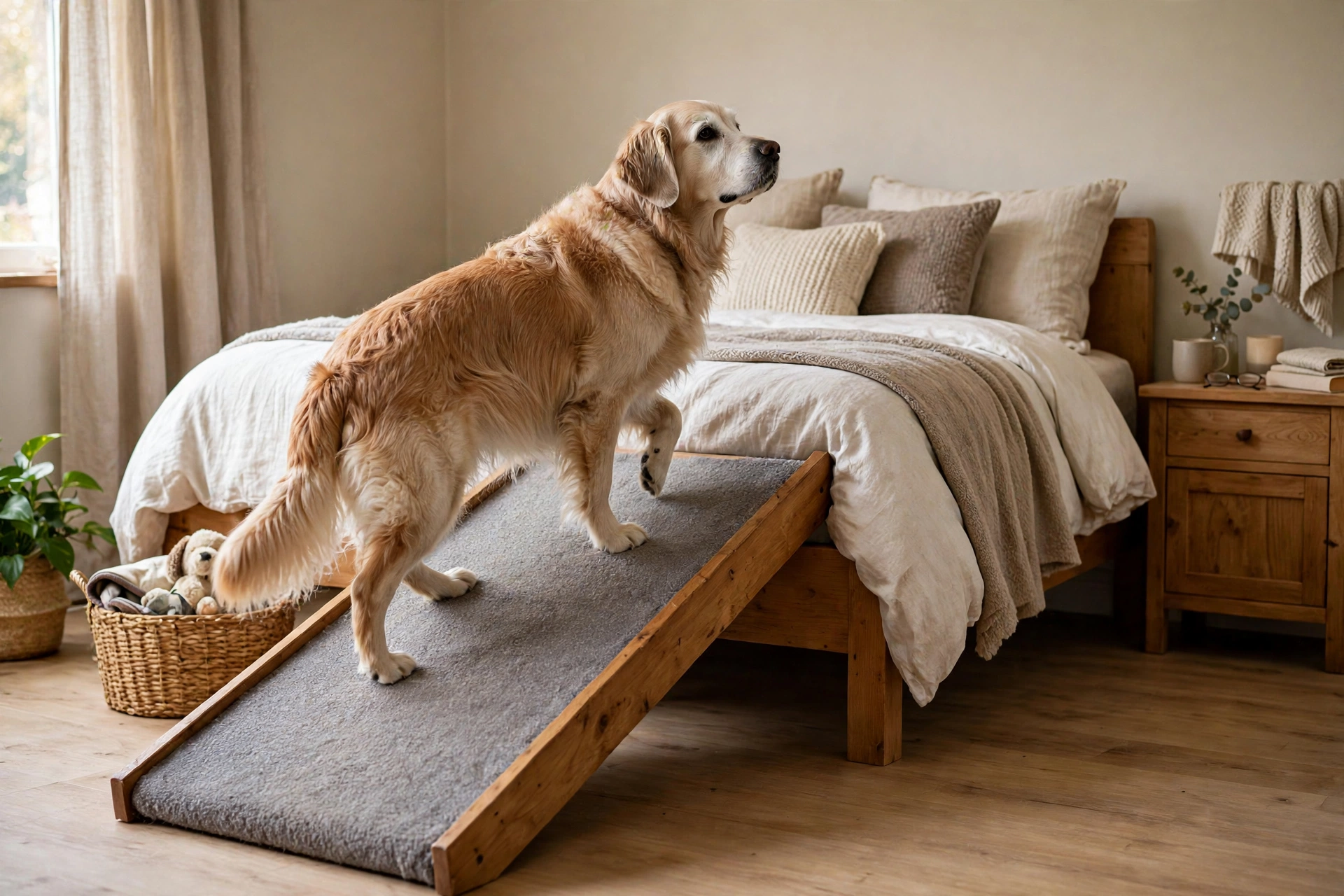
Senior dogs and breeds prone to joint issues often do better with a gentle ramp than with stairs. A low incline removes the up-and-down stepping motion entirely.
Materials: One plywood board (about 36 inches long, 14 inches wide), two short wooden legs, carpet runner or non-slip rug, wood screws, sandpaper.
Instructions:
- Attach the two short legs to one end of the board to set a gentle slope — aim for a rise of about 20 inches over 36 inches of run.
- Sand the board smooth, then cover the top surface with carpet or a non-slip rug secured with staples or strong adhesive.
- Add a small lip at the bottom edge so the ramp cannot slide away from the bed.
- Introduce the ramp gradually: lure your dog up with treats over several short sessions before expecting independent use.
Helpful pick: Joytale 30ft Dog Training Leash — guide nervous dogs up and down the ramp safely while they learn.
7. Landing Cushion Convertible Set

Build a simple two-step frame and make the top landing double as a cushioned bed. Your dog gets stairs and a daytime nap spot in the same footprint.
Materials: Two wooden boxes or step frames (descending heights), fabric to wrap them, a round calming dog bed for the top landing, staple gun, screws.
Instructions:
- Build or buy two descending-height frames, each roughly 16 inches wide, and connect them firmly with screws.
- Wrap both frames in your chosen fabric, stapling neatly underneath.
- Place the calming bed on the top landing — it cushions the final step and gives your dog a perch to survey the room.
- During the day, the landing bed works as a nap spot; at night, it is the final step up to your bed.
- Vacuum the landing cushion weekly, since it collects the most paw traffic.
Helpful pick: Bedsure Calming Donut Dog Bed — sized perfectly for a step-top landing that doubles as a cozy nap spot.
Safety Tips for Every Build
Match the step height to your dog: each step should be no more than half your dog’s shoulder height. Anchor every build against the bed so it cannot shift, add non-slip surfaces to each tread, and supervise the first week of use until your dog climbs confidently. If your dog shows pain while climbing even with steps, check in with your vet.
Keep Reading
- 9 DIY Dog Bed Frames That Look Like Real Furniture
- 7 DIY Dog Bunk Beds for Multi-Dog Homes
- 15 Indoor Dog Park Ideas for Rainy Days
- 10 Hotel Ideas for Dogs
- 10 Adorable Dog Photo Ideas
Frequently Asked Questions
How tall should DIY dog steps be?
Measure your mattress height from the floor, then build steps that reach within a few inches of the top. Three steps with 6–8 inch rises suit most beds, while lower, wider steps work better for senior dogs.
Are dog stairs or ramps better for seniors?
Ramps are gentler on arthritic joints because they remove the stepping motion entirely. Stairs are fine for healthy small dogs but a low incline ramp is the safer choice for seniors and large breeds recovering from injury.
How do I teach my dog to use the steps?
Place treats on each step and let your dog explore at their own pace over several short sessions. Never force or push your dog — most dogs figure it out within a few days when the climb is rewarded.
How do I stop the steps from sliding?
Place a non-slip rug pad or shelf liner under the base, push the unit flush against the bed frame, and anchor taller builds to the bed frame or wall with a small bracket.
What fabric is best for covering dog steps?
Upholstery fabric, microsuede, and polar fleece all work well because they grip paws and are easy to spot-clean. Avoid slippery fabrics like satin, and choose machine-washable options when possible.
As an Amazon Associate, PetPostHub earns from qualifying purchases.