
16 DIY Cat Wall Ideas to Transform Your Space and Pamper Your Pet

If your cat treats your curtains, bookshelves, and counters like a private climbing gym, these diy cat wall ideas are the answer. Wall-mounted cat furniture turns wasted vertical space into a playground your cat will actually use, and it looks far better than a bulky carpeted tree. Below are 16 buildable ideas, from simple floating perches to full cat highways.
Table of Contents
- 1. Corner Cube Lounge + Rope Bridge
- 2. Honeycomb Wall Modules
- 3. Staggered Floating Staircase
- 4. Sisal-Wrapped Climbing Ladder
- 5. Above-the-Door Cat Highway
- 6. Window-Side Sunset Perch Row
- 7. Curved Wave Step Path
- 8. Hanging Suspension Bridge
- 9. Multi-Level Wall Playground
- 10. Greenery Shelf Walkway
- 11. Cat Balcony Overlook with Bowl Station
- 12. Crescent-Moon Hammock Shelf
- 13. Wall-Mounted Scratching Pole Column
- 14. Floating Cloud Lounge Platforms
- 15. Mini Wall Cubby Hideaway
- 16. Beginner’s Three-Perch Starter Run
- FAQ
1. Corner Cube Lounge + Rope Bridge

Mount two open-front wooden boxes at different heights, then connect them with a small rope-and-plank bridge. Your cat gets a hideaway, a lookout, and a wobbly walkway to patrol in between. Secure every box into wall studs, and keep the bridge spans short so the cat always feels stable.
Helpful pick: VEVOR Wall-Mounted Cat Shelves (Set of 4) — a ready-made set if you’d rather skip the build.
2. Honeycomb Wall Modules

Build or buy a few hexagon shelf boxes and cluster them like a honeycomb. Cats love curling inside the compartments, and the geometric pattern looks like modern wall art. Arrange the openings so your cat can hop from one cell to the next without big jumps.
Helpful pick: COZIWOW Cat Wall Shelves 5-Piece Set — a complete kit with house, bridge, and platforms.
3. Staggered Floating Staircase

A zigzag row of small floating steps is the classic cat-wall starter. Space the steps so the vertical gap matches your cat’s easy jump — usually 12 to 16 inches. Cover the tops with carpet tiles or rubber mats so landings stay grippy and quiet.
Helpful pick: Dluno Triangle Floating Shelf Brackets — sturdy hidden brackets for each step.
4. Sisal-Wrapped Climbing Ladder

Bolt two slim rails to the wall and connect them with sisal-wrapped dowels. The result works as both a climbing ladder and a vertical scratching surface, which is great for cats that shred furniture. Wrap the sisal tightly and glue the ends so nothing unravels.
Helpful pick: HTJZWG 164-Feet Sisal Rope — plenty of rope for rungs and rewraps.
5. Above-the-Door Cat Highway

The empty strip above a doorway is prime cat real estate. Run two or three long shelves over the door frame and connect them to nearby perches, giving your cat a patrol route that crosses the whole room. Anchor at least one bracket per shelf into a stud.
Helpful pick: WEKIS Heavy-Duty Floating Shelf Brackets — heavy-duty brackets rated for serious loads.
6. Window-Side Sunset Perch Row

Place two or three perches in a gentle arc beside a window so your cat can chase sunbeams and watch birds. A soft washable mat on each perch makes it the nap spot of the house. Keep the perches a comfortable jump apart so senior cats can manage.
Helpful pick: LIORCE Wave Cat Wall Shelf — a wave-shaped shelf built for lounging.
7. Curved Wave Step Path

Instead of straight rectangles, cut your boards into gentle curves and sweep them across the wall in a wave. The path looks sculptural, and cats enjoy the variety of landing shapes. Seal the wood with a pet-safe finish and add thin cork pads for traction.
Helpful pick: FOYUEE Hidden Floating Shelf Brackets — hidden supports keep the floating look clean.
8. Hanging Suspension Bridge

Thread wooden slats onto two sturdy ropes and hang the bridge between two solid perches. Most cats walk it confidently within a few days — put their favorite treats on the far side the first time. Use thick rope and keep the span under three feet for stability.
Helpful pick: Opvixi 164-Feet Sisal Rope — thick natural rope for bridges and walkways.
9. Multi-Level Wall Playground

Combine everything — two platforms, a sisal scratching post, and a small house — into one connected layout. This is the project for energetic young cats that need serious daily activity. Build in layers from the floor up, testing each level for wobble before moving on.
Helpful pick: KAMABOKO 5-Piece Cat Wall Furniture Set — house, hammock, steps, and scratcher in one box.
10. Greenery Shelf Walkway

Style your cat shelves with trailing faux plants to create a jungle walkway. The greenery softens the look of the wall and gives shy cats cover as they move between perches. Use cat-safe faux plants — never real plants with toxic leaves.
Helpful pick: VEVOR Wall-Mounted Cat Shelves (Set of 6) — six pieces to style with your greenery.
11. Cat Balcony Overlook with Bowl Station

Build one extra-wide platform and add a raised food and water bowl station. Elevated dining helps some cats eat more comfortably, and the platform doubles as a lookout post. Because bowls add weight and daily vibration, stud-mounting is essential here.
Helpful pick: Solexu Digital Stud Finder — find studs accurately before you drill.
12. Crescent-Moon Hammock Shelf
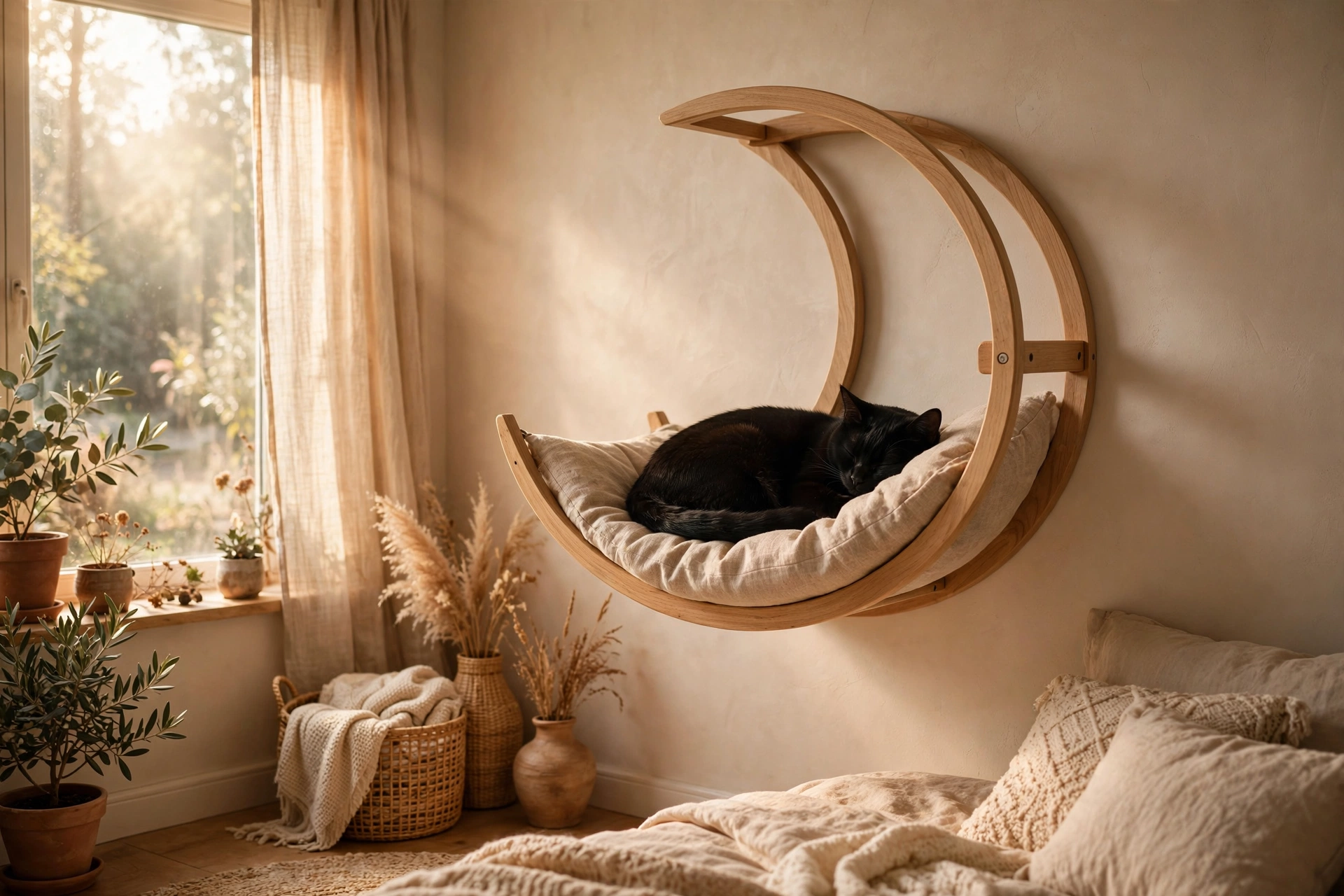
Cut a crescent-moon shape from plywood and stretch fabric across the curve to make a cradling hammock. Cats sink into the soft curve and sleep for hours. Reinforce the horns of the moon so the frame keeps its shape under a full-size cat’s weight.
Helpful pick: Franklin Sensors ProSensor T9 Stud Finder — precise stud detection for heavy pieces.
13. Wall-Mounted Scratching Pole Column

Mount a tall sisal-wrapped post vertically on the wall instead of standing it on the floor. Cats get their full body stretch without the post tipping over, and you reclaim floor space. Leave a perch at the top so the climb ends with a reward.
Helpful pick: OSPNIEEK Sisal Scratching Post Replacements — pre-wrapped posts that mount like a column.
14. Floating Cloud Lounge Platforms

Make your platforms extra deep — 14 inches or more — and top them with washable foam cushions. These cloud lounges become the primary nap zones, especially for senior cats that want comfort without climbing high. Space them with smaller, easier jumps.
Helpful pick: Majhulla Sisal Rope Repair Kit — add a wrapped scratching post beside the lounge zone.
15. Mini Wall Cubby Hideaway

Build a small enclosed box with a round entry hole and mount it at a medium height. Shy cats love the security of a hideaway that still lets them watch the room. Line the inside with a soft pad and keep the entry wide enough for your largest cat.
Helpful pick: eOUTIL Electronic Stud Finder — locate studs fast for enclosed-box mounting.
16. Beginner’s Three-Perch Starter Run

If you’re new to DIY, start with just three plain wood perches in a vertical row. It’s a weekend project that teaches you cutting, sanding, and stud mounting — and your cat gets instant vertical territory. You can always add bridges and boxes later.
Helpful pick: WEKIS 12-Inch Shelf Brackets (8-Pack) — extra brackets for your future expansions.
Keep Reading
- 12 Crochet Cat Hammock Ideas Your Kitty Will Adore
- 11 Cozy Crochet Cat Sweater Patterns Your Pet Will Love
- 14 Cat Food Bowl Ideas Your Kitty Will Absolutely Adore
- 6 Clever Cat Corner Ideas Your Feline Will Adore
Frequently Asked Questions
How much weight should cat wall shelves hold?
Aim for shelves rated to at least 30 pounds per perch, even though most cats weigh far less. Cats launch themselves with force, so build for impact, not just resting weight.
Do I have to drill into studs?
For the main anchors, yes — stud mounting is the safest option. Heavy-duty drywall anchors can work for light pieces, but anything your cat will jump on deserves a stud connection.
What materials are safest for DIY cat shelves?
Untreated pine, birch plywood, and solid wood are all good choices. Avoid pressure-treated lumber and use pet-safe finishes, and skip small parts or toxic glues a cat could chew.
How far apart should cat wall steps be?
Most cats comfortably jump 12 to 18 inches vertically. Start smaller for kittens, seniors, or heavier cats, and watch your cat’s first climbs before finalizing the layout.
Can renters build a cat wall?
Yes — choose a single wall with solid backing, use minimal anchors, and plan on spackling and touch-up paint when you move out. Some renters use freestanding leaning shelves instead.
As an Amazon Associate, PetPostHub earns from qualifying purchases.





6 Comments