Cooked Dog Food Recipes for Beginners (2026)
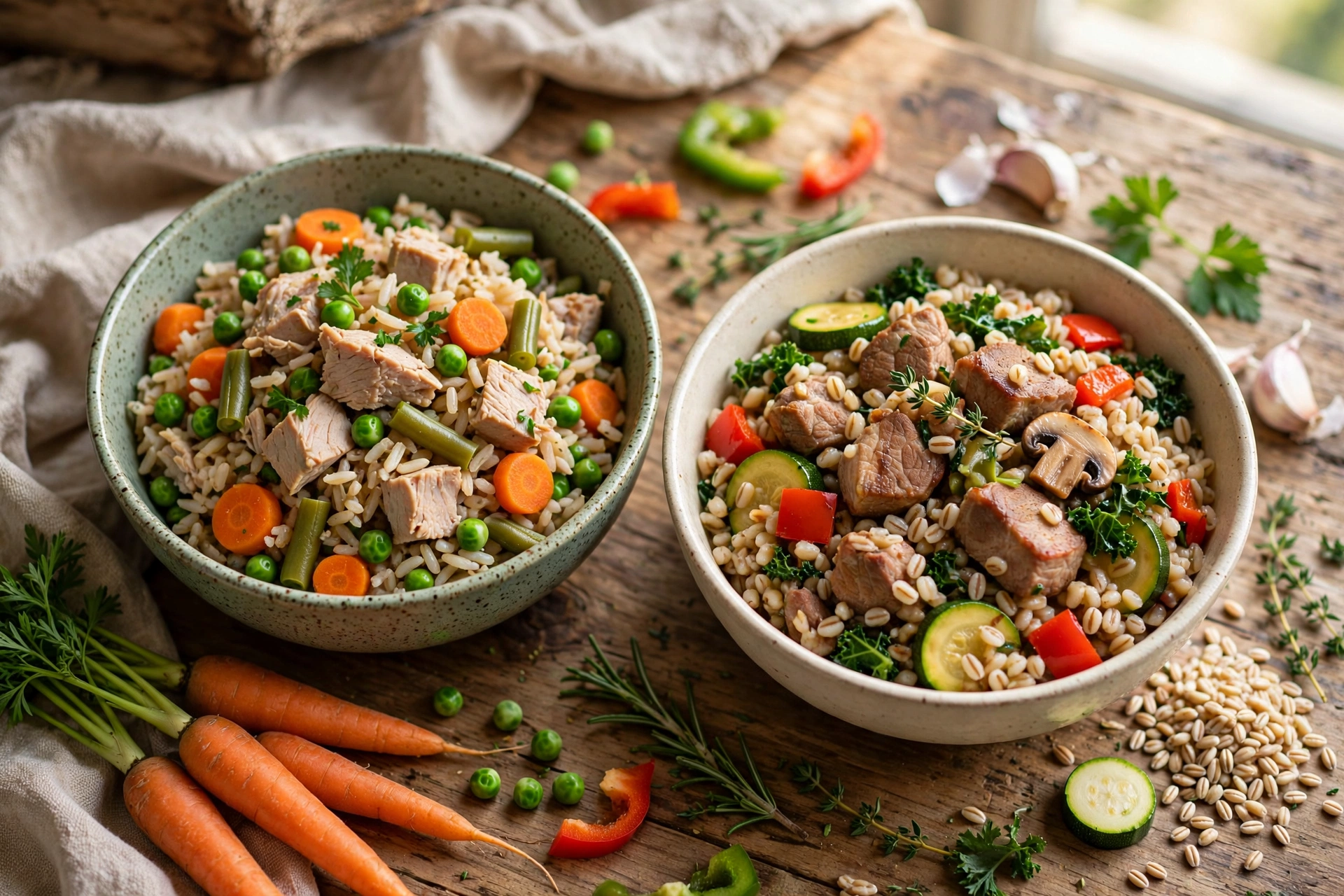
If you have been curious about cooked dog food recipes but feel stuck at the starting line, you are in good company. Most beginners picture long ingredient lists, expensive supplements, and confusing meal plans — and quietly give up before they ever turn on the stove. The reality is friendlier: you can start with two simple, forgiving cooked dog food recipes that use everyday grocery-store ingredients, take under an hour each, and give your dog fresh, wholesome nutrition. This guide walks you through both, step by step, with portion charts, storage rules, and beginner safety basics included.
Table of Contents
- Why Cook for Your Dog?
- What Beginners Should Know First
- Recipe 1: Turkey & Carrot One-Pot Bowl
- Recipe 2: Pork & Barley Skillet Supper
- Portion and Serving Sizes
- Storage Instructions
- Frequently Asked Questions
- Keep Reading
Why Cook for Your Dog?
Home cooking gives you something no bag or can ever can: complete control over what goes into your dog’s bowl. You choose the protein, skip the fillers and artificial preservatives, and adjust everything to your dog’s appetite, allergies, and age.
The real prize of starting now is confidence: after two or three batches, you will understand protein-to-carb balance instinctively and be able to build a bowl without a recipe.
One honest note: these beginner recipes are a strong starting point, not a forever-complete diet. Dogs eating home-cooked food long-term need steady calcium, omega-3s, and trace minerals that simple recipes cannot fully supply. Your vet can advise on a supplement if you make homemade food a permanent lifestyle.
What Beginners Should Know First
Keep these four rules in mind and you will avoid almost every common beginner mistake.
Check with your vet first. This matters most if your dog has kidney disease, diabetes, a history of pancreatitis, or food allergies. A quick call keeps your experiments safe.
Transition slowly. Over 7 to 10 days, mix increasing amounts of the cooked food into current meals while reducing the old food — jumping straight to 100% homemade usually causes loose stools.
Keep it plain. No salt, onion, garlic, spices, or butter. Dogs do not need seasoning, and several common ones are genuinely toxic to them.
Watch your dog’s response. In the first weeks, notice energy, stool quality, coat condition, and weight — these signals tell you whether portions and ingredients are working.
Two Beginner Cooked Dog Food Recipes
Recipe 1: Turkey & Carrot One-Pot Bowl
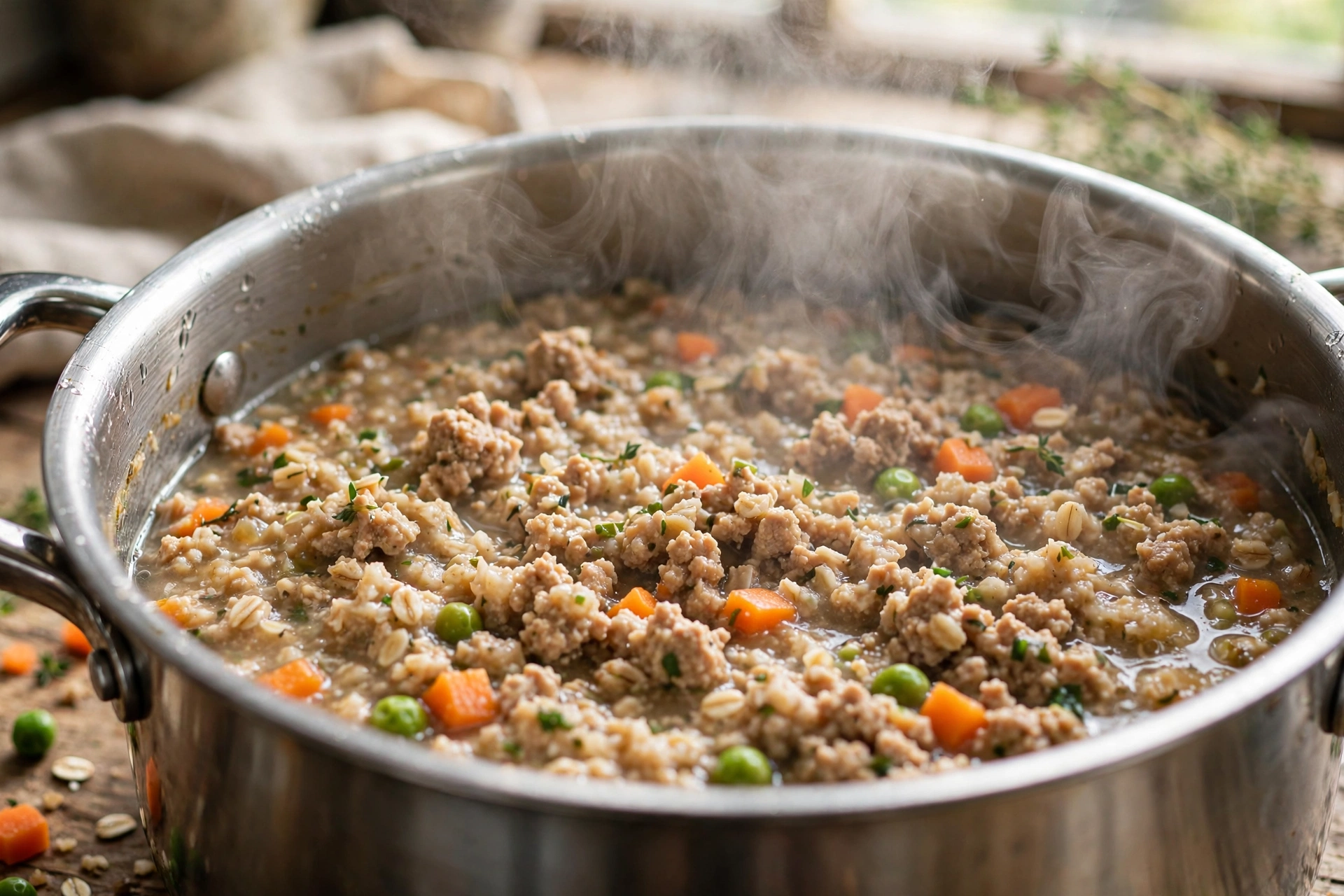
This is the gentlest recipe to start with. Ground turkey is lean, easy to digest, and widely loved by dogs. Carrots and peas add fiber and vitamins, oatmeal brings steady energy, and the whole thing cooks in a single pot — less cleanup while you are still learning.
| Ingredient | Amount |
|---|---|
| Lean ground turkey (93% lean or higher) | 1½ pounds |
| Rolled oats (not instant) | 1½ cups |
| Carrots, peeled and diced small | 2 cups |
| Frozen peas | 1 cup |
| Fish oil or flaxseed oil | 1 tablespoon |
| Water | 4 cups |
- Brown the turkey. Place the ground turkey in a large pot or Dutch oven over medium heat. Break it into small crumbles, about 8 to 10 minutes, until no pink remains. Drain off excess liquid so the final mixture is not soupy.
- Add the water and bring to a boil. Pour in the 4 cups of water, scrape up the browned bits, and raise the heat until it boils.
- Stir in the oats. Add the rolled oats, reduce the heat to low, and cover. Simmer gently for 8 minutes, stirring once halfway so the oats do not stick.
- Add the carrots and peas. Stir in the diced carrots, cover again, and simmer for another 10 to 12 minutes until the carrots mash easily with a fork. Stir in the peas during the last 3 minutes — they need very little cooking.
- Check the texture. It should look like a thick, hearty porridge. Too watery? Simmer uncovered a few more minutes. Too thick? Stir in a splash of water.
- Cool and finish. Remove from the heat and rest 30 minutes. Once at room temperature, drizzle the fish or flaxseed oil over the top and stir through evenly.
- Portion and store. Divide into meal-sized portions in airtight containers. Refrigerate for up to 4 days or freeze for up to 3 months.
Easy variations: Swap carrots for diced zucchini or chopped green beans. For a senior who struggles with chunks, mash a serving with a fork before it goes in the bowl. Replace peas with chopped spinach added in the last 2 minutes.
Recipe 2: Pork & Barley Skillet Supper
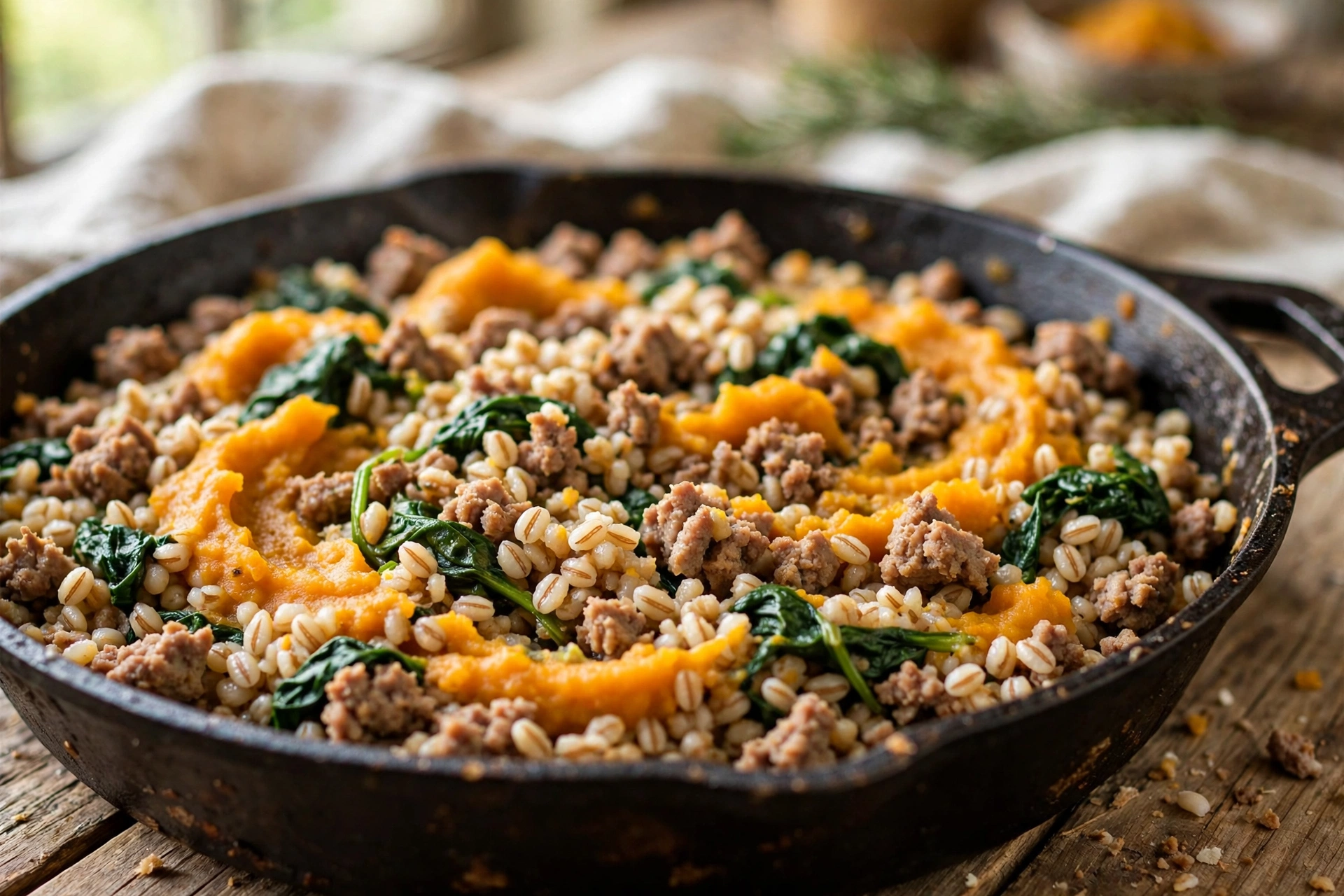
Once you are comfortable with the one-pot method, this skillet recipe adds a little more technique and nutritional variety. Lean pork brings a different amino-acid profile than turkey, pearled barley delivers slow-release energy plus fiber, spinach adds iron and antioxidants, and pumpkin puree supports smooth digestion.
| Ingredient | Amount |
|---|---|
| Lean ground pork | 1½ pounds |
| Pearled barley, rinsed | 1¼ cups |
| Fresh spinach, roughly chopped | 2 cups packed |
| Plain canned pumpkin puree (not pie filling) | ½ cup |
| Olive oil | 1 tablespoon |
| Low-sodium chicken broth or water | 4 cups |
- Start the barley. Combine the rinsed barley and broth or water in a large pot. Boil, then reduce to a low simmer, cover, and cook about 35 minutes, until the grains are tender with a slight chew.
- Brown the pork. While the barley cooks, heat a large skillet over medium-high heat. Add the ground pork and cook 10 to 12 minutes, breaking it into kibble-sized crumbles, until no pink remains. Drain off any excess fat.
- Wilt the spinach. Add the chopped spinach to the hot pork skillet and stir for 2 to 3 minutes until it wilts down — it looks like a mountain at first, then collapses to almost nothing.
- Combine everything. Fold the cooked pork-and-spinach mixture and the pumpkin puree into the finished barley. Stir well so the pumpkin coats every grain and crumble.
- Add the oil. Drizzle the olive oil over the mixture and stir through — healthy fats help your dog absorb the fat-soluble vitamins in the spinach and pumpkin.
- Cool completely. Let the batch cool at room temperature for 30 to 45 minutes (spread it on a baking sheet to speed this up).
- Portion and store. Divide into meal-sized servings, refrigerate for up to 4 days, or freeze individual portions for up to 3 months.
Easy variations: Replace spinach with chopped kale (tough stems trimmed) in the same step. Cooked brown rice works as a one-for-one swap for barley. If your dog has a sensitive stomach, hold the pumpkin increase for the first batch and add it later once you know it agrees with them.
Portion and Serving Sizes
These are daily starting points — split each day’s amount into two meals. A sedentary or senior dog may need less; a young, athletic dog may need more. The truest guide is your dog’s body condition: you should be able to feel (but not see) the ribs, with a visible waist from above.
| Dog Size | Daily Amount |
|---|---|
| Small dogs (10–20 lbs) | 1 to 1½ cups per day |
| Medium dogs (20–50 lbs) | 2 to 3 cups per day |
| Large dogs (50–80 lbs) | 3 to 4½ cups per day |
| Giant breeds (80+ lbs) | 4½ to 6 cups per day |
Weigh your dog every two weeks during the first month of home cooking. Steady weight means the portions are right; gradual gain or loss means adjusting slightly.
Storage Instructions
Good storage keeps homemade food safe and fresh-tasting. Never leave cooked dog food at room temperature for more than 2 hours.
Refrigerator: Keep portions in airtight glass or BPA-free containers at 40°F or below and use within 4 days. Give the food a quick smell and visual check before each serving — if anything seems off, throw it out.
Freezer: Freeze in individual meal-sized portions, labeled with recipe name and date. Both recipes keep their quality for up to 3 months frozen.
Thawing: Move a frozen portion to the refrigerator 24 hours before serving. Never thaw at room temperature, and never refreeze thawed food.
Frequently Asked Questions
Can I cook for my dog every day? Yes — these recipes are built for exactly that. Just keep vet check-ins on your calendar and discuss adding a calcium and multivitamin supplement if homemade meals become the main diet.
Are these recipes safe for puppies? Puppies under a year have stricter calcium and calorie needs for growing bones. These meals are fine occasionally, but puppies should not be fed exclusively on them without a vet-approved puppy plan.
Can I use the slow cooker instead of the stove? Yes for both. Cook the turkey bowl on low for 4 hours (peas in the last 30 minutes) and the pork-and-barley combo on low for 5 hours, stirring the spinach and pumpkin in at the end.
What if my dog has food allergies? That is one of the best reasons to cook at home — you control every ingredient. If your dog is sensitive to poultry, stick with the pork recipe; if pork is the issue, the turkey bowl is your friend. Test one new protein at a time.
How do I know the portions are right? The scale and your eyes. Weigh your dog every two weeks and check body condition: ribs easy to feel under a thin layer of fat, a visible waist from above and the side. Adjust portions up or down in small steps.