Why Does My Dog Wag His Tail Sideways? 5 Meanings Explained

Ever watched your dog wag his tail and wondered exactly what he’s trying to say? If you’ve noticed that your pup seems to favor one side, you’re probably asking why does my dog wag his tail sideways — and whether it means something different from a regular wag. The short answer is yes: a sideways-biased wag carries real emotional information, and scientists have actually measured it.
Tail wagging isn’t just a happiness meter. It’s a complex signal shaped by your dog’s brain, his arousal level, and the situation he’s in. A neuroscience study out of Italy found that dogs wag more to the right when they feel positive, approachable emotions — and more to the left when they feel uncertain or wary.
Table of Contents
- 1. Right-Side Bias: A Wag That Means Happy and Relaxed
- 2. Left-Side Bias: A Wag That Means Uneasy or Wary
- 3. The Full-Body Helicopter Wag: Pure Playfulness
- 4. Slow vs. Fast Wag: Speed Tells You the Intensity
- 5. Tail Position Context: The Side Is Only Half the Story
- How to Read the Whole Dog (Not Just the Tail)
- Frequently Asked Questions
1. Right-Side Bias: A Wag That Means Happy and Relaxed
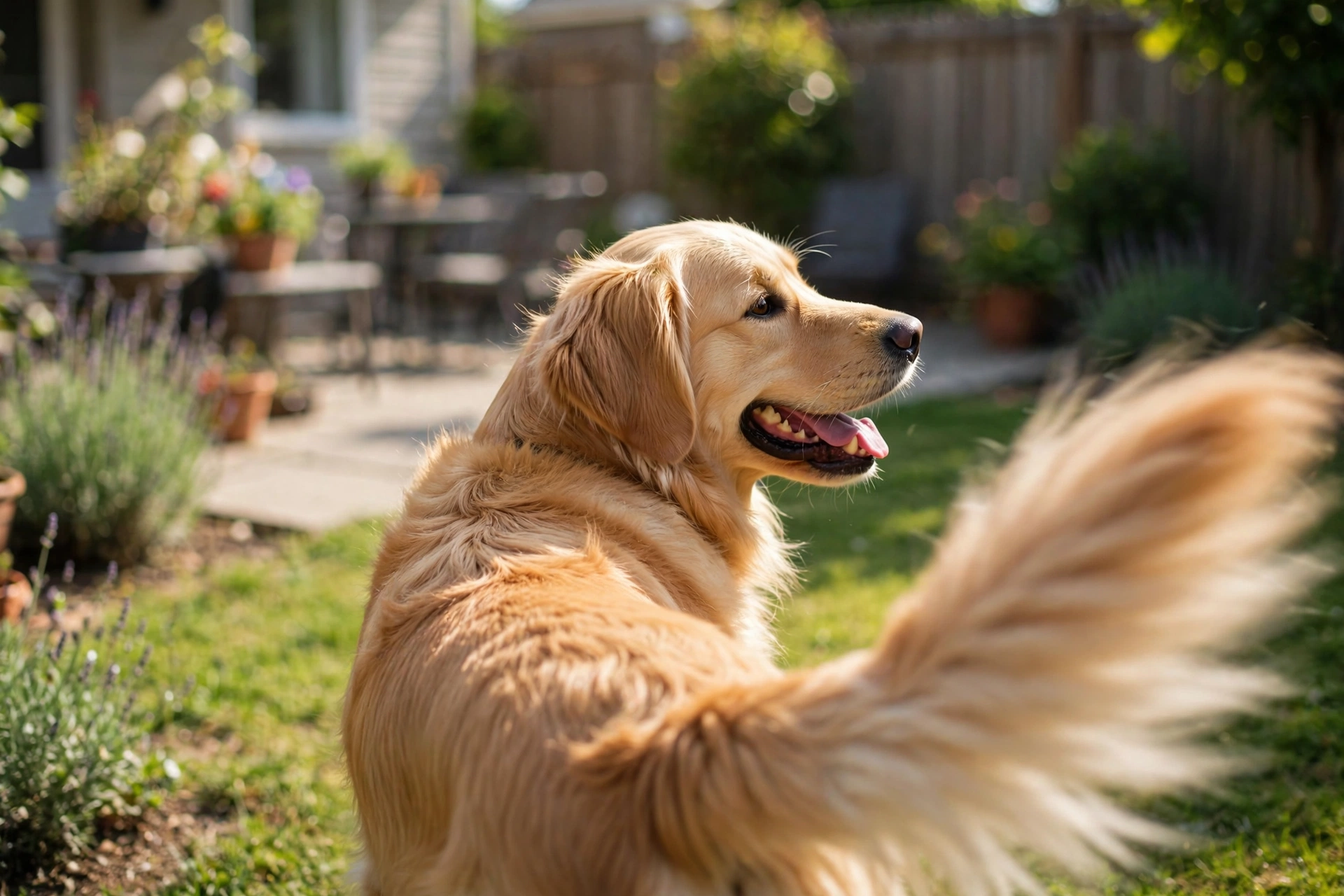
A wag that leans toward your dog’s right side is the friendliest signal on this list. In a 2007 study published in Current Biology, researchers at the University of Trento and the University of Bari filmed 30 dogs as they were shown their owner, an unfamiliar person, a cat, and an unfamiliar dominant dog. The result was striking — dogs wagged with bigger swings to the right when they saw something they wanted to approach, like their owner.
The reason comes down to brain wiring. The left hemisphere of the brain is associated with approach-type, positive emotions, and because each hemisphere controls the opposite side of the body, left-brain activation shows up as a right-sided wag. In plain terms: a right-leaning wag usually means your dog feels good about what’s in front of him.
What to do: Enjoy it — this is the green light. Greet him warmly, offer praise or a treat, and let the positive interaction roll on. Dogs give this wag when they’re greeting family members, meeting friendly people, or anticipating something fun like a walk.
Helpful pick: The Little Dipper Treat Pouch — keep treats on your hip so you can reward those happy, confident greetings the moment they happen.
2. Left-Side Bias: A Wag That Means Uneasy or Wary

A wag that favors the left side tells a different story. In that same Italian study, dogs shown an unfamiliar, dominant-looking dog wagged with a strong bias to the left — a withdrawal response linked to right-hemisphere activation, which handles avoidance-type emotions like fear and anxiety. A follow-up study in 2013 even found that other dogs react to this signal: when dogs watched videos of a left-biased wag, their heart rates rose and they showed signs of stress, while right-biased wags kept them relaxed.
So if your dog’s tail drifts left when a stranger approaches, a new dog appears at the park, or a loud noise goes off, he’s not being rude — he’s telling you he’s unsure. If you often notice this pattern, our guide to signs your dog is stressed can help you spot the other clues.
What to do: Give him space. Don’t force the interaction or drag him toward the scary thing. Create distance calmly, let him observe from a comfortable spot, and reward calm behavior with gentle praise. Forcing a nervous dog to “say hi” is the fastest way to turn unease into a snap.
Helpful pick: Zesty Paws Calming Chews for Dogs — formulated with L-theanine and chamomile to support relaxation during the everyday situations that make your dog uneasy.
3. The Full-Body Helicopter Wag: Pure Playfulness

Some sideways wags are so big they barely stay sideways. The helicopter wag — where the tail circles and the entire back half of the dog wiggles along with it — is the most joyful signal a dog can broadcast. The whole body gets involved: loose hips, a bouncy stance, and often a play bow or a big open-mouthed grin.
This wag is all about invitation. Your dog isn’t just feeling good — he’s actively trying to pull you into the fun. Dogs do this at the dog park, when a favorite playmate shows up, or when you reach for the toy box. Similar whole-body excitement shows up in other playful behaviors too, like spinning when excited.
What to do: Say yes to playtime — but on your terms. Channel that explosive energy into a structured game like fetch so he burns it off instead of bouncing off the furniture. End the session before he’s totally exhausted, and give him a calm cooldown so he learns that wild play has a clear on-off switch.
Helpful pick: Chuckit! Ultra Ball (2-Pack) — ultra-bouncy and durable for high-energy fetch sessions that match your helicopter-wagging dog’s enthusiasm.
4. Slow vs. Fast Wag: Speed Tells You the Intensity

Direction is only one dial; speed is another. A slow, loose side-to-side wag usually reflects low arousal — your dog is content, relaxed, or mildly curious. Think of a dog lying on the rug gently thumping his tail as you walk past. There’s no urgency there, just a quiet “I see you, and all is well.”
A fast wag, on the other hand, means high arousal — but arousal is not the same as happiness. Dogs wag fast when they’re thrilled and also when they’re tense, so speed has to be read together with the direction and the rest of the body. A fast right wag with a wiggly body is delight; a fast left wag with a stiff body is agitation.
What to do: Match your response to the intensity. A slow wag deserves calm acknowledgment — a soft voice, gentle petting. A fast wag means the emotional volume is cranked up, so either direct that energy into activity or de-escalate the situation before it boils over. Mental enrichment is one of the best ways to keep arousal in a healthy range, because a tired brain settles a busy body.
Helpful pick: Outward Hound by Nina Ottosson Treat Tumble — an interactive puzzle ball that gives your dog a fun problem to solve, burning off mental energy that might otherwise turn into frantic wagging.
5. Tail Position Context: The Side Is Only Half the Story

The sideways bias means the most when you also check where the tail sits vertically. A sideways wag from a high tail signals confidence or assertiveness — a dog standing tall, ears forward, wagging side to side is engaged and possibly challenging. A sideways wag from a neutral, relaxed-height tail is the everyday friendly wag. And a sideways wag from a low or tucked tail is a dog trying to make himself small while still signaling — insecurity with a social garnish.
Breeds complicate things: a pug’s curled tail and a greyhound’s low-slung tail sit at different “neutral” points, so compare your dog against his own baseline, not other dogs.
What to do: Build a mental snapshot of your dog’s normal: his neutral tail height, his typical wag speed, his usual direction. Once you know his baseline, deviations become easy to read. And always read the tail as part of the full picture — ears, eyes, mouth, and posture all vote.
Helpful pick: XIGOU Dog Rope Toy (3 Feet, 5 Knots) — interactive tug games build two-way communication, and the better you know each other’s signals, the faster you’ll read that tail.
How to Read the Whole Dog (Not Just the Tail)
The tail is one instrument in a full orchestra. For a reliable read on your dog’s mood, scan in this order: body posture (loose vs. stiff), ears (forward vs. pinned), eyes (soft vs. hard stare), mouth (relaxed pant vs. closed, tense lips), and then the tail’s direction, speed, and height. When all five agree, the message is clear; when they disagree, trust the stiffest, tensest signal — that’s usually the true emotion.
Context is the other half of the equation. The same right-sided fast wag at the front door when you come home (pure joy) means something different at the vet’s office (high arousal, mixed feelings). If you want to get serious about canine body language, our complete dog body language guide breaks down every signal from nose to tail, and our article on signs your dog loves you covers the sweetest positive signals of all.
Frequently Asked Questions
Does a dog wagging its tail always mean it’s happy?
No. Tail wagging signals emotional arousal, not happiness specifically. Dogs wag when excited, anxious, frustrated, and even aggressive. The direction, speed, and height of the wag — plus the rest of the body — determine the real meaning.
Why does my dog wag his tail more to the right when he sees me?
That’s a compliment. Research shows dogs wag with a stronger right-side bias when they see their owner — a signal linked to left-brain activation and approach-type, positive emotions. Your dog is telling you he’s genuinely glad you’re there.
Should I worry if my dog’s tail wags to the left around strangers?
A consistent left bias around strangers suggests wariness rather than friendliness. It’s not an emergency, but it’s a cue to give him space and let him approach on his own terms. If the left bias comes with stiffness, raised hackles, or growling, take it as a warning and create distance calmly.
What does it mean when my dog’s whole body wiggles while wagging?
The full-body wiggle — sometimes called the helicopter wag — is a sign of overwhelming joy and a play invitation. It’s one of the most purely positive signals dogs give. Match it with interactive play, but end sessions before your dog gets overstimulated.
Can a dog control which way his tail wags?
Not consciously. The side bias is an involuntary byproduct of which brain hemisphere is more active during the emotional response. That’s exactly why it’s such a trustworthy signal — your dog can’t fake it.
As an Amazon Associate, PetPostHub earns from qualifying purchases.