
Dog Separation Anxiety: 9 Proven Ways to Help Your Dog Stay Calm
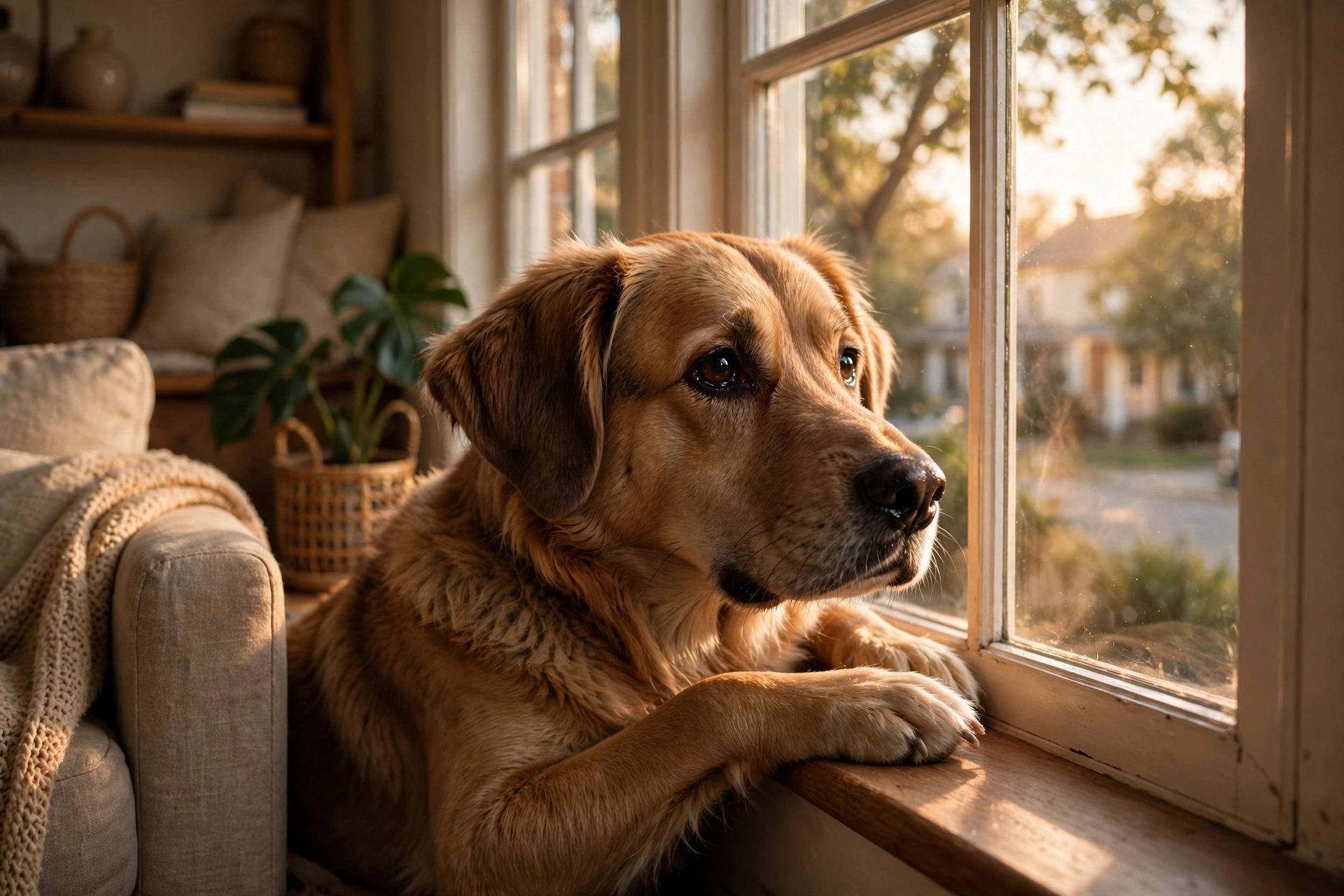
Coming home to shredded pillows, scratched doors, or a neighbor’s note about the barking is heartbreaking — but your dog isn’t being “bad.” What you’re seeing is dog separation anxiety, a genuine panic response that hits millions of dogs when their favorite person walks out the door. The good news: it’s one of the most treatable behavior problems out there, and you don’t need harsh methods or expensive programs to fix it.
Below are 9 proven, vet- and behaviorist-backed ways to help your dog feel safe alone — starting with the small daily tweaks that make the biggest difference, and ending with when it’s time to call in a professional. Let’s turn those panicked goodbyes into calm, boring ones.
Table of Contents
- Signs Your Dog Has Separation Anxiety
- 1. Desensitize Your Departure Cues
- 2. Practice Graduated Absences
- 3. Build a Calm Departure Routine
- 4. Leave a Frozen Kong (or Long-Lasting Enrichment)
- 5. Play Calming Music or White Noise
- 6. Train a Cozy Crate or Safe Space
- 7. Exercise Your Dog Before You Leave
- 8. Try Adaptil or Vet-Approved Calmatives
- 9. Know When to Call a Behaviorist
- What NOT to Do
- Frequently Asked Questions
Signs Your Dog Has Separation Anxiety
Not every destructive dog is anxious — but separation anxiety has a telltale pattern: the trouble happens only when you’re gone, usually within the first 30 minutes, and often near exits. Watch for:
- Barking, howling, or whining that starts soon after you leave
- Chewing or scratching at doors, windows, and crates (escape attempts)
- Pacing, panting, or drooling when they sense you’re about to go
- House-soiling by an otherwise house-trained dog
- Frantic, over-the-top greetings when you return — as if they feared you’d never come back
Rule out medical issues first. A vet check matters because pain, urinary problems, or cognitive decline in senior dogs can mimic anxiety. Once health is cleared, the training plan below is your roadmap. If your dog’s panic is severe — injuring themselves or breaking through doors — skip straight to Way 9 and loop in a professional.
1. Desensitize Your Departure Cues
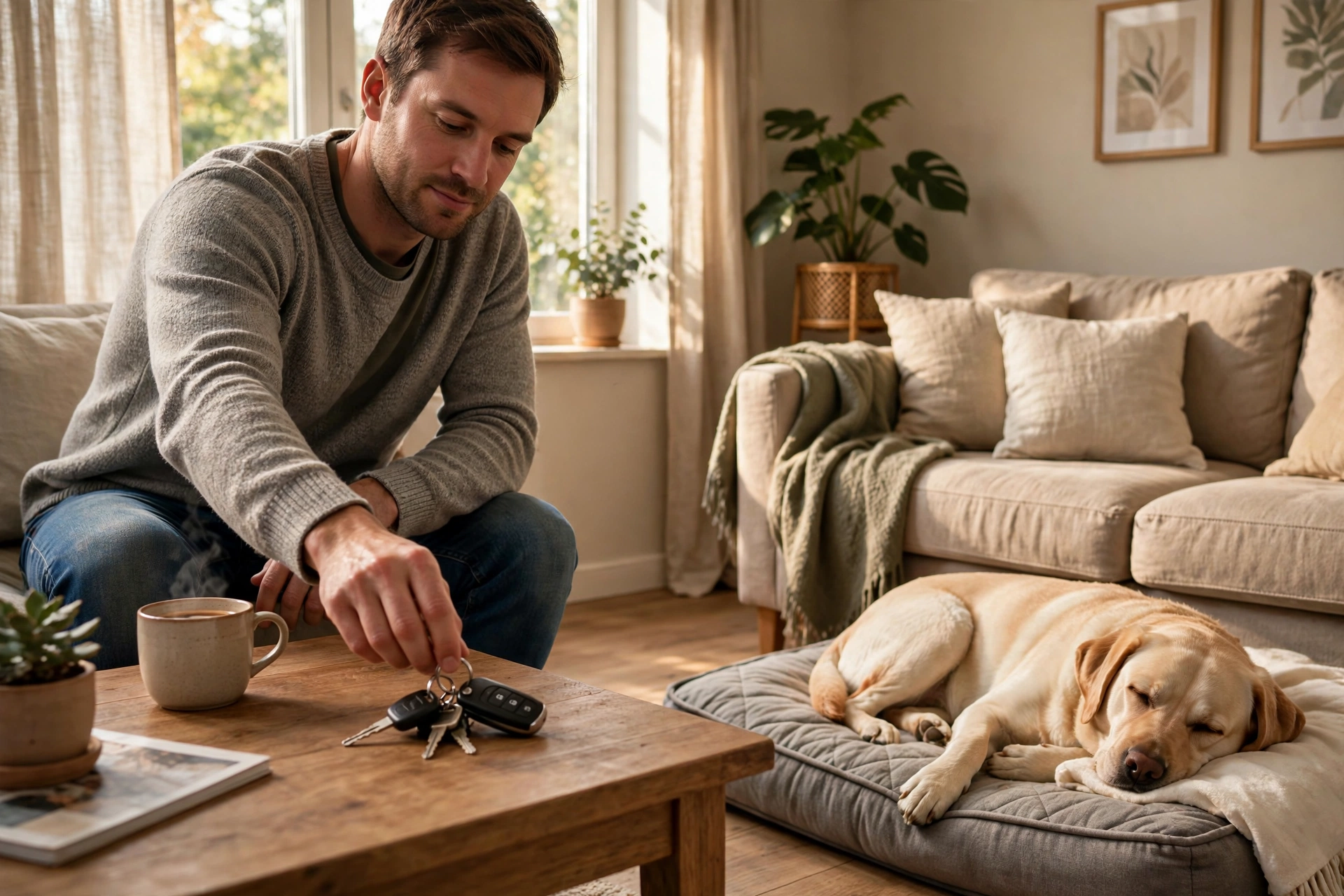
Dogs are brilliant pattern-readers. Shoes on, keys jingled, bag grabbed — and your dog’s stress spikes before you’ve even touched the doorknob. These are “departure cues,” and you can drain their power with simple desensitization: pick up your keys and sit back down. Put on your shoes, then make coffee. Grab your bag, then watch TV.
Do this a dozen times a day with no departure attached, and the cues stop predicting scary alone-time. Within a week or two, most dogs visibly relax when the keys jingle. It’s the cheapest, fastest win on this list — and it makes every other technique work better.
Helpful pick: Furbo 360° Dog Camera — check in on your dog during practice absences so you know exactly when calm kicks in.
2. Practice Graduated Absences
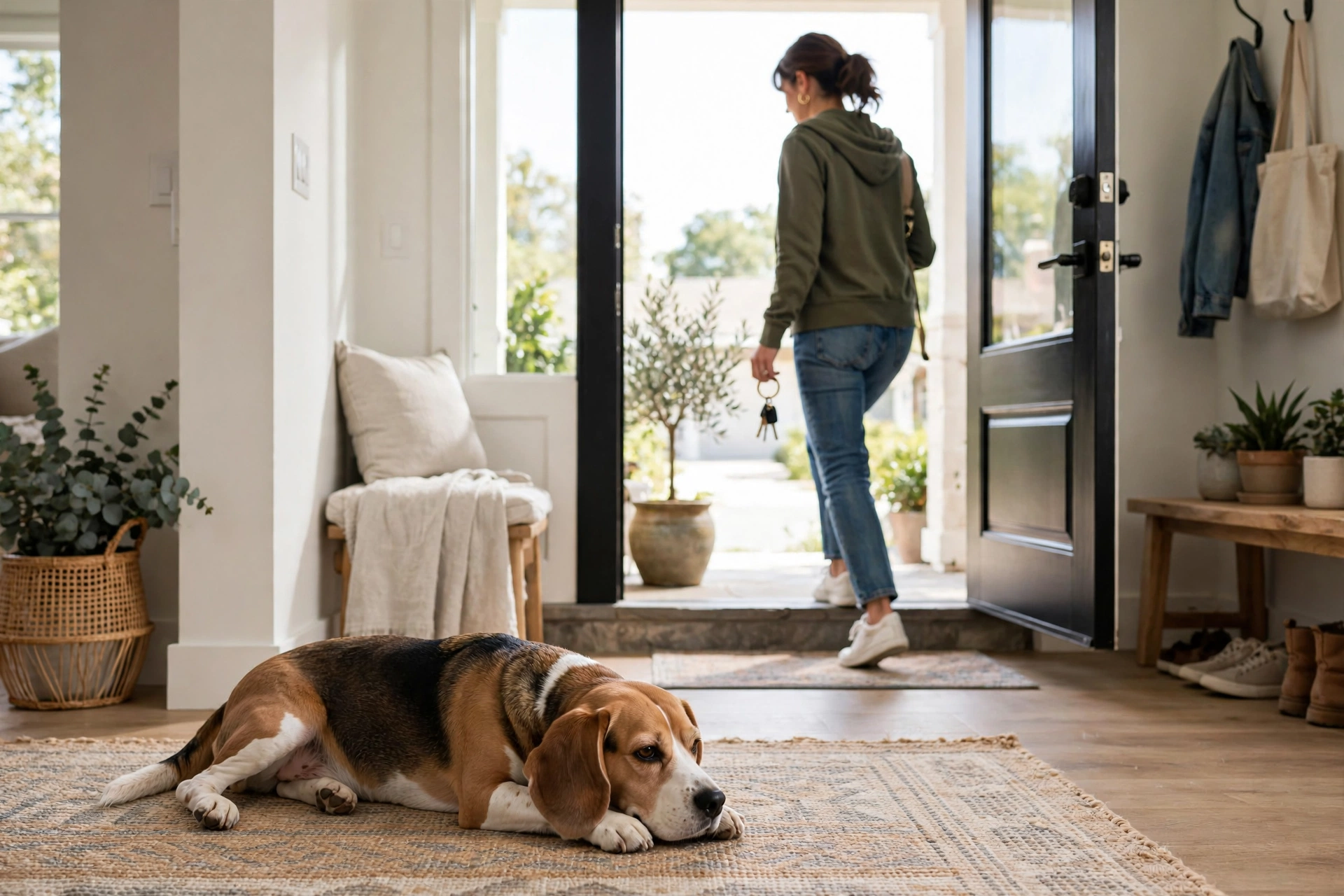
This is the gold-standard treatment veterinary behaviorists recommend: teach your dog that alone-time is safe by increasing it in tiny, panic-free steps. Start absurdly small — step outside the door for 5 seconds, come back before your dog gets upset, and reward calm. Then 15 seconds. Then a minute. Then five.
The rule is simple: never push past the point of panic. If your dog gets distressed at 3 minutes, drop back to 90 seconds and build again. Most dogs can work up to 30–60 minutes within a few weeks of daily 10-minute sessions. Keep a simple log (date, duration, reaction) — seeing the numbers climb is incredibly motivating. Pair this with the calm-behavior training methods that teach your dog to settle on cue.
Helpful pick: STMK Dog Treat Pouch & Clicker Training Kit — mark and reward every calm alone-moment with perfect timing.
3. Build a Calm Departure Routine
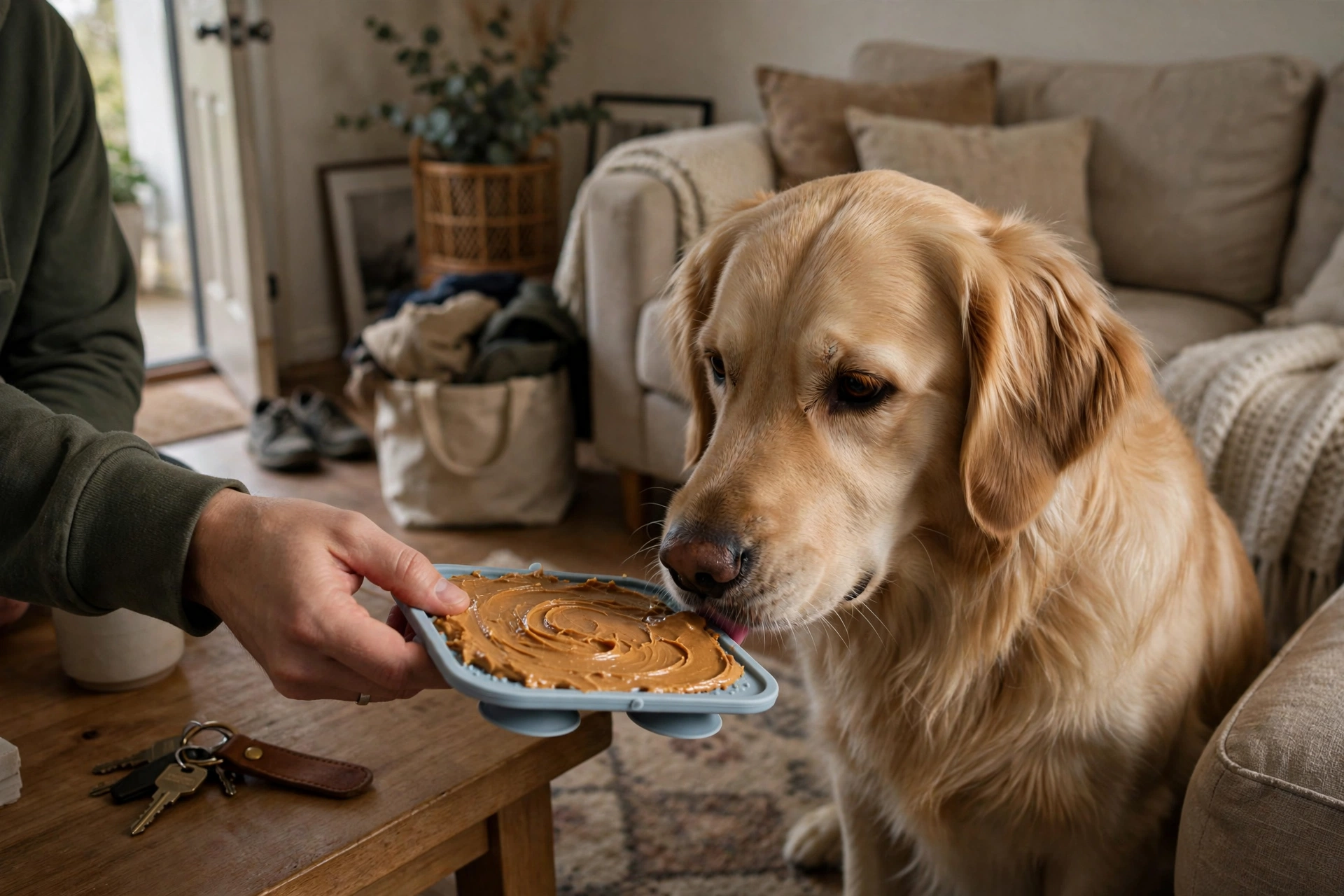
Long, emotional goodbyes (“Mommy will miss you SO much, be a good boy!”) accidentally teach your dog that departures are a big, scary deal. Flip the script: make leaving boring. Five minutes before you go, stop the petting and fuss. Give a small stuffed toy or lick mat, say a neutral cue like “be right back” in a cheerful-but-flat tone, and walk out.
Keep arrivals equally dull — no squealing reunion for the first few minutes. This isn’t coldness; it’s kindness. A predictable, low-drama ritual tells your dog’s nervous system: this happens every day, nothing bad follows, they’ll be back. Dogs who learn the routine often start settling onto their bed the moment they hear the cue.
Helpful pick: LickiMat Classic Soother — spread peanut butter on it as a calming 15-minute departure ritual.
4. Leave a Frozen Kong (or Long-Lasting Enrichment)
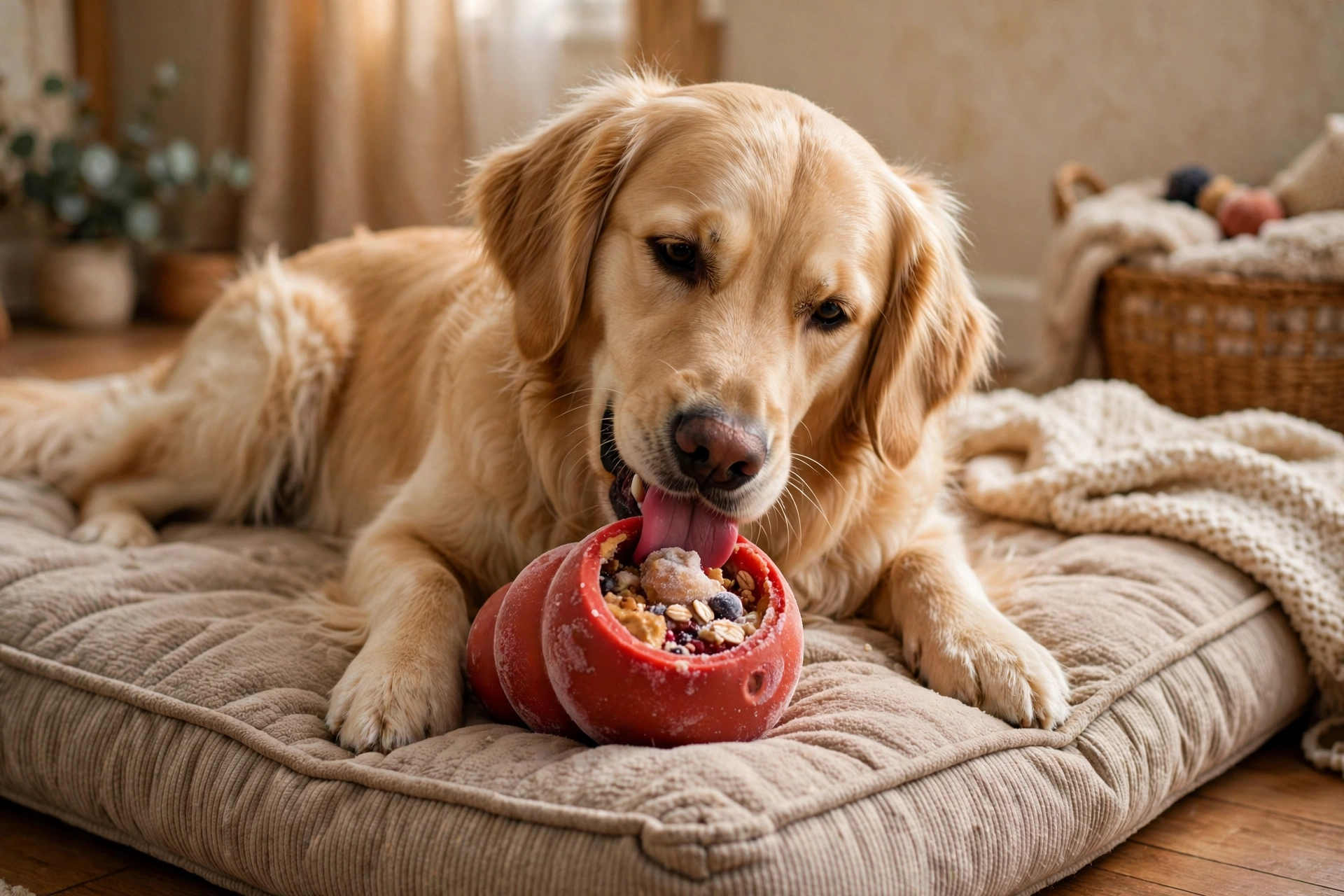
Counter-conditioning is a fancy term for a simple idea: pair your departure with something your dog loves, and alone-time starts feeling like treat-time. The classic tool is a Kong stuffed with peanut butter, banana, or kibble — then frozen overnight so it takes 20–40 minutes to finish. Hand it over only as you leave, and pick it up when you return, so it becomes a departure-exclusive jackpot.
Rotate the fillings to keep it novel: plain yogurt, pumpkin purée, blueberries, a smear of cream cheese. For power chewers, size up to the black Extreme line. The licking and problem-solving also release calming endorphins, which is why this works even for moderately anxious dogs.
Helpful pick: KONG Classic Stuffable Dog Toy — the gold standard for frozen enrichment; stuff it the night before.
5. Play Calming Music or White Noise
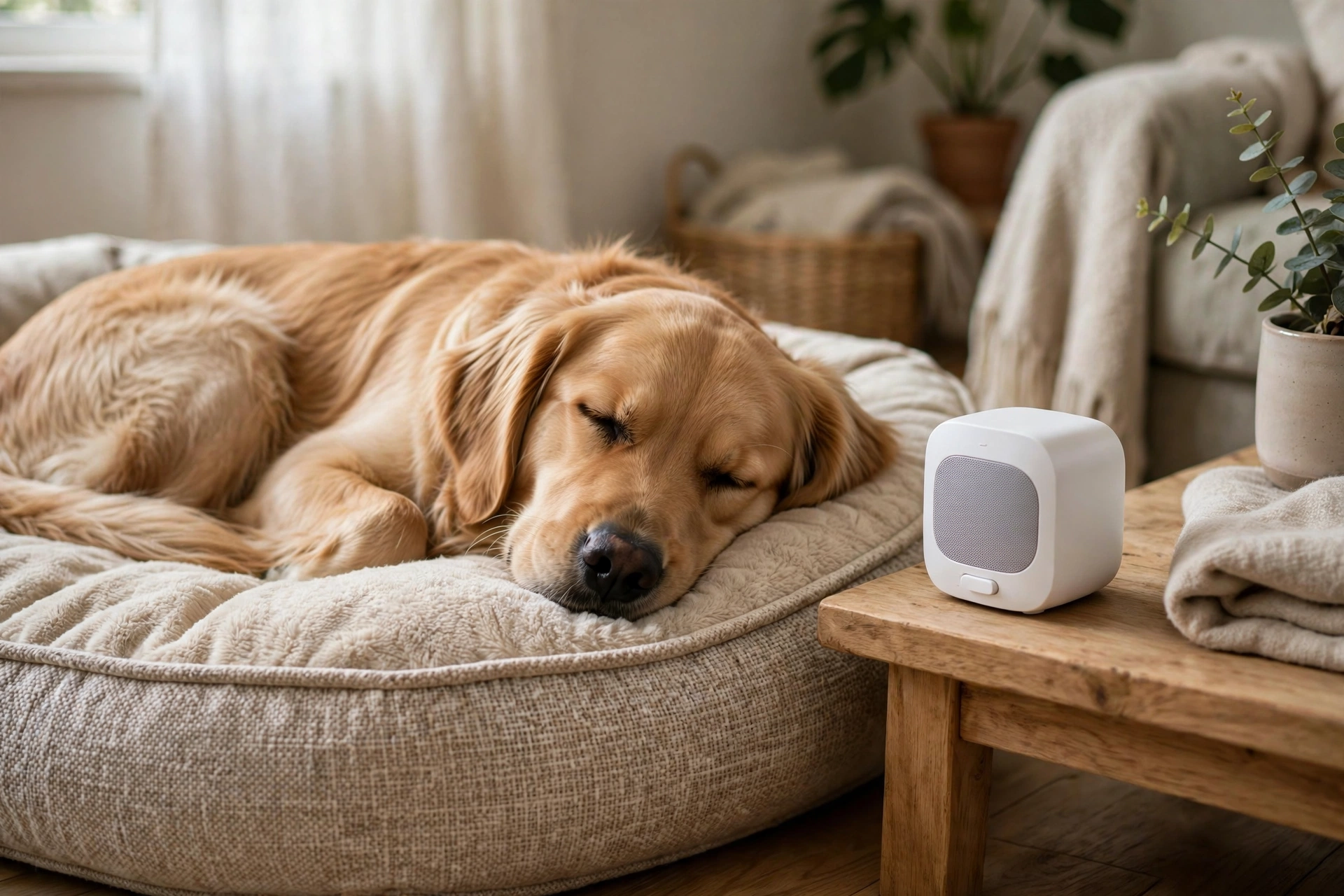
Silence can be stressful — every hallway footstep or car door becomes a startling event. A steady background sound masks those triggers and creates an auditory “blanket.” Research on shelter dogs has found that soft classical music and reggae reduce stress behaviors like barking and standing, while heavy metal does the opposite (skip the playlists).
White noise machines work beautifully because the sound is constant and non-looping. Place one near your dog’s resting spot, at a moderate volume — loud enough to blur outside noises, not so loud it adds stress. Start it 10 minutes before you leave so it becomes part of the calm-departure ritual from Way 3.
Helpful pick: Yogasleep Pawzz White Noise Machine for Dogs — six calming sounds plus a bark sensor that auto-plays soothing audio.
6. Train a Cozy Crate or Safe Space
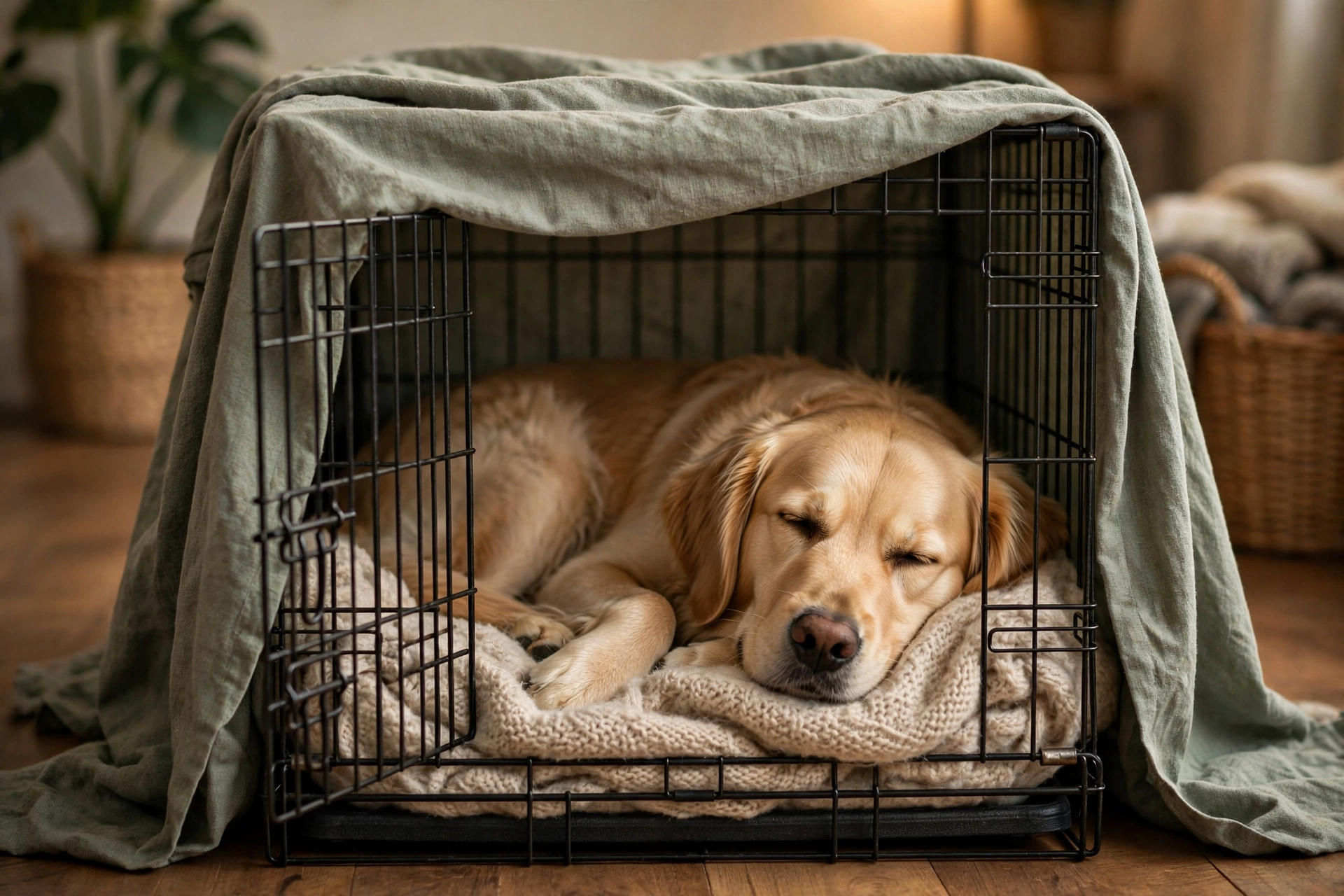
A crate should feel like a bedroom, never a jail cell. Done right, crate training gives an anxious dog a den — a small, predictable space that actually lowers arousal. The key is building the association slowly: feed every meal in the crate with the door open, toss treats in for voluntary visits, and only close the door for seconds at first, always with something good inside.
Drape a cover over three sides to make it den-like and dim, and keep the crate in a lived-in room rather than isolation. Important caveat: if your dog panics in the crate — drooling, bending bars, bloody paws — the crate is making things worse. Switch to a dog-proofed room instead; confinement must never cause injury. Our crate buying guide covers sizing and styles if you’re starting fresh.
Helpful pick: MidWest Dog Crate Cover — turns a wire crate into a dark, den-like retreat that eases anxiety.
7. Exercise Your Dog Before You Leave
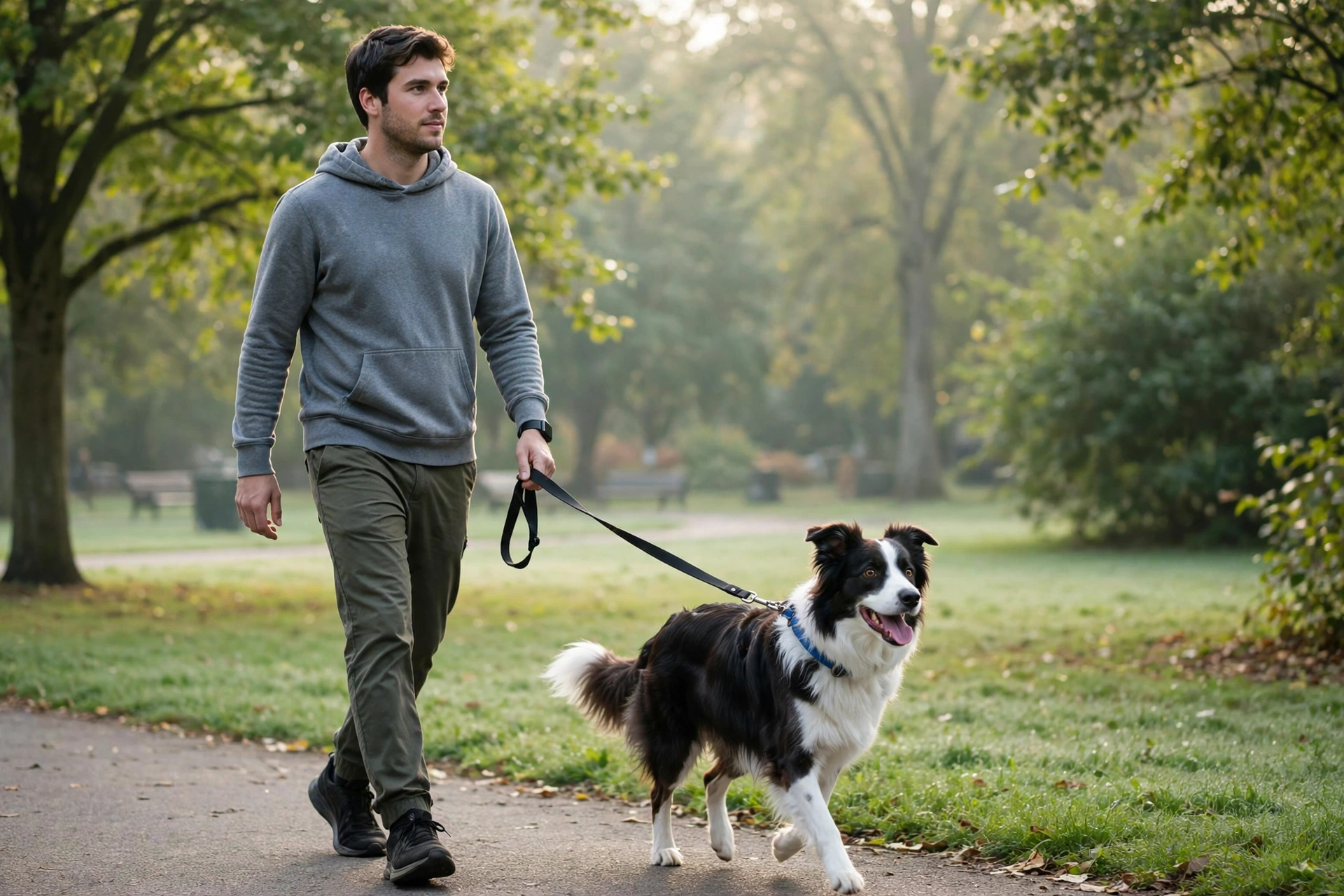
A dog with a full tank of unspent energy is far more likely to panic — exercise won’t cure separation anxiety on its own, but it lowers the baseline arousal that feeds it. Aim for a solid walk, fetch session, or sniffy exploration 30–60 minutes before your longest absence. Mental exercise counts double: 15 minutes of nose work or training tires most dogs out more than an hour of aimless walking.
Watch the timing, though. Don’t sprint home, leash up, and dash out the door — that frantic energy transfers straight to your dog. Build in a 20-minute cool-down after exercise: calm petting, water, then the departure ritual. A pleasantly tired dog with a frozen Kong is a dog set up to succeed.
Helpful pick: Snuffle Mat for Dogs — ten minutes of nose work before you leave burns more energy than a quick lap around the block.
8. Try Adaptil or Vet-Approved Calmatives
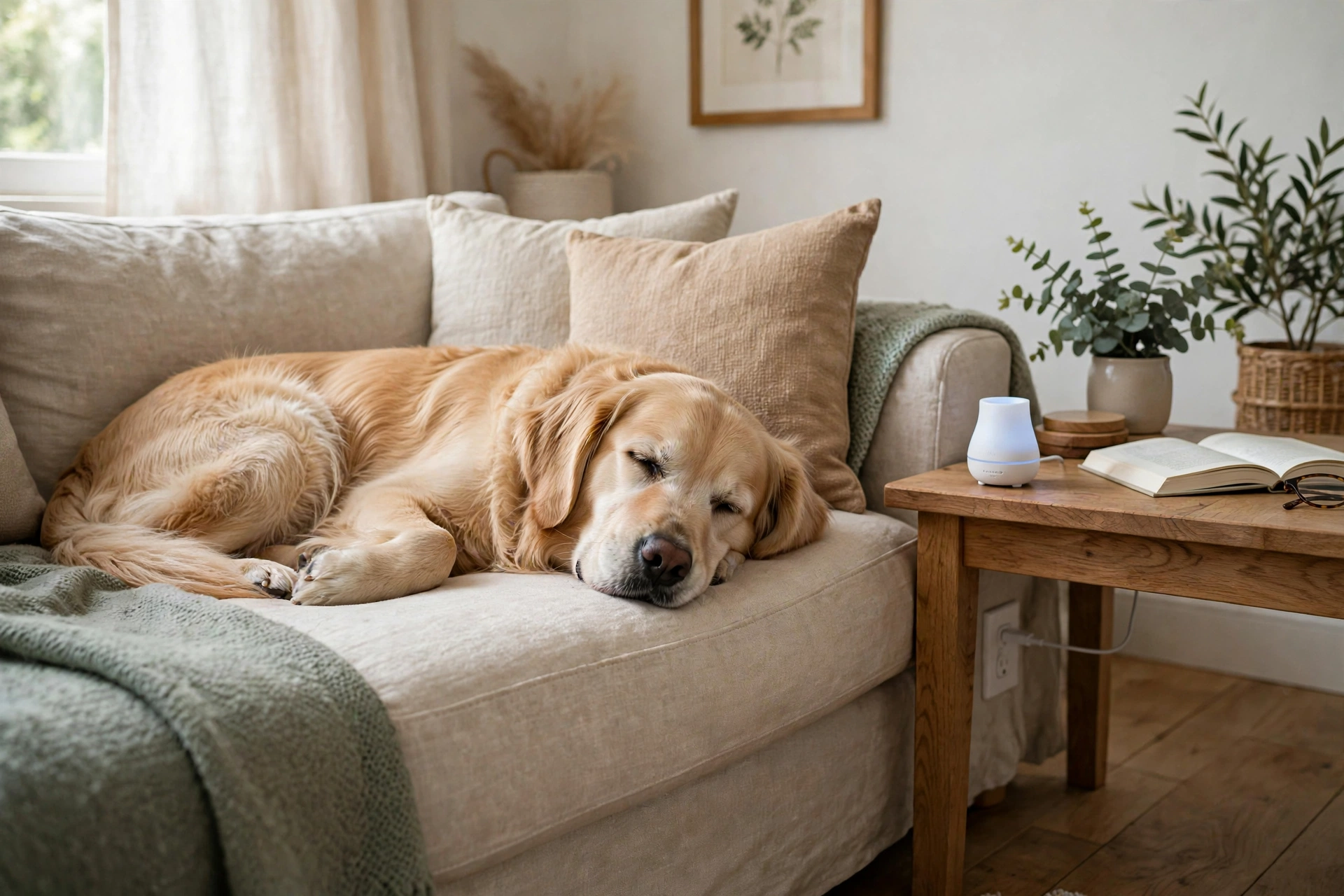
For dogs who need extra support while the training kicks in, calming aids can take the edge off. Adaptil (a synthetic copy of the pheromone mother dogs produce) comes as a plug-in diffuser or collar, and clinical trials show it reduces anxiety behaviors in many dogs. It’s odorless to humans and has no sedative effect — it simply signals “safe.”
Other vet-approved options include calming chews with L-theanine or casein, and compression wraps. Always talk to your vet first — especially for severe cases, where prescription medication (like fluoxetine or clomipramine, the two FDA-approved options for canine separation anxiety) combined with behavior modification works far better than either alone. Never use human sleep aids or essential oils without veterinary guidance; many are toxic to dogs.
Helpful pick: ADAPTIL Calm Diffuser Kit — clinically tested pheromone support to use alongside training.
9. Know When to Call a Behaviorist
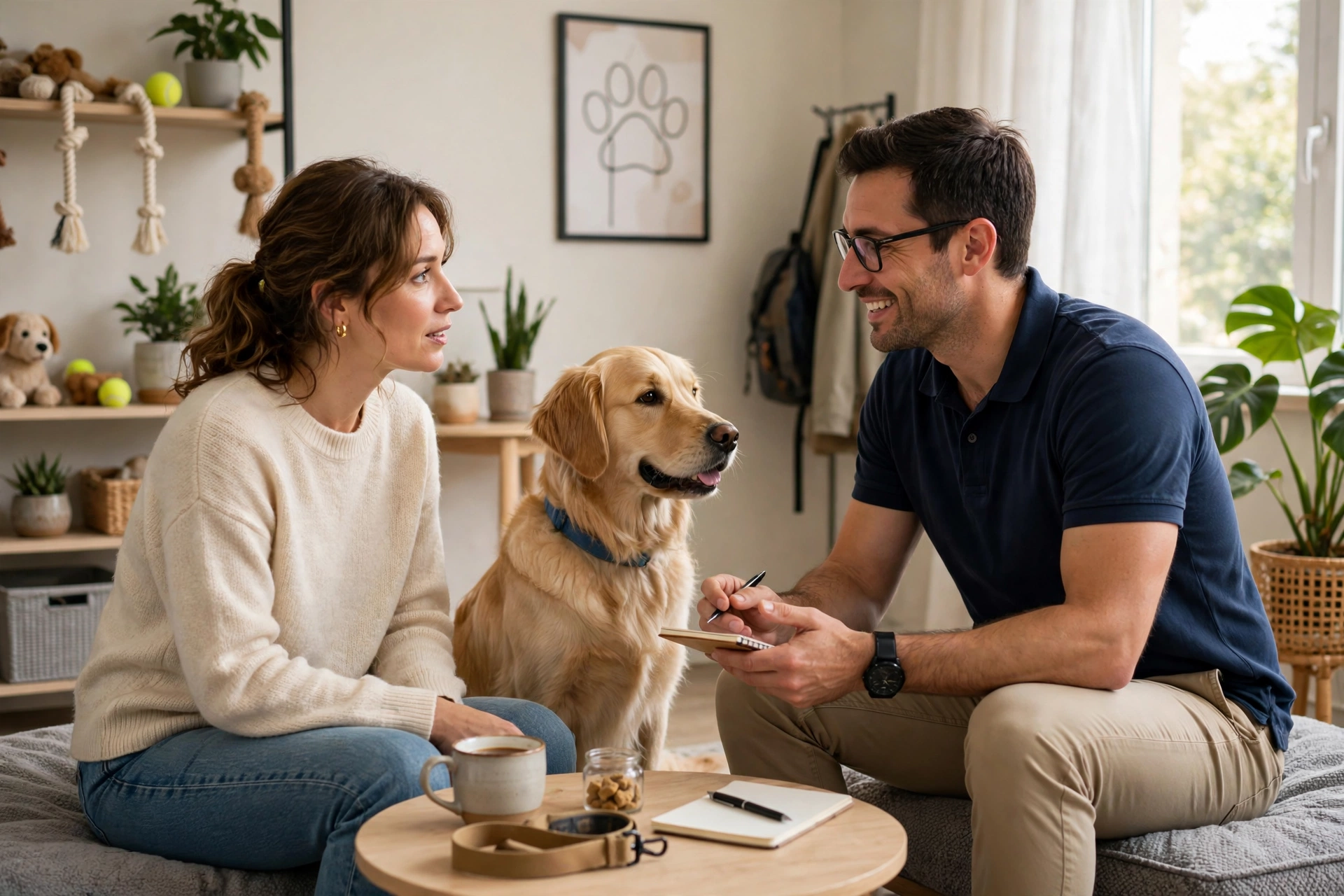
If you’ve worked the plan for 4–6 weeks with zero progress — or your dog is hurting themselves, destroying doors, or panicking the instant you reach for your coat — it’s time for professional help. And that’s not failure; severe separation anxiety is a clinical condition, like a phobia, and it responds best to expert guidance.
Look for a Certified Separation Anxiety Trainer (CSAT) or a veterinary behaviorist (DACVB) — many work remotely via video, watching your dog through a camera while coaching you live. They’ll design a graduated-absence protocol tailored to your dog and coordinate with your vet on medication if needed. Most owners who go this route wish they’d called sooner: with the right plan, even severe cases improve dramatically.
Helpful pick: SmartPetLove Snuggle Puppy — a heartbeat comfort toy behaviorists often recommend as a soothing aid during training.
What NOT to Do
A few common responses feel intuitive but reliably make separation anxiety worse:
- Don’t punish the destruction. Your dog isn’t being spiteful — punishment after the fact teaches them nothing except that your return is scary too.
- Don’t get a second dog “for company.” It rarely fixes true separation anxiety (the panic is about you), and you may end up with two anxious dogs. If you’re considering it anyway, read our boarding questions guide mindset: plan, don’t impulse-decide.
- Don’t crate a panicking dog and hope they “get used to it.” Flooding an anxious dog with confinement can cause injuries and deepen the phobia.
- Don’t sneak out. Dogs always notice eventually, and the unpredictability raises baseline anxiety.
- Don’t rely on sedatives alone. A groggy dog can still panic — they just can’t move well. Training plus support beats sedation every time.
Frequently Asked Questions
How long does it take to fix separation anxiety in dogs?
Mild cases often improve within 2–4 weeks of consistent graduated-absence training. Moderate to severe cases typically take 2–6 months, especially if medication is part of the plan. Consistency matters more than speed — every panic-free repetition rewires the association.
Can separation anxiety be cured completely?
Many dogs reach a point where they’re genuinely relaxed alone for a full workday. Some remain mildly sensitive to big routine changes and need occasional refresher training. Think of it as managed into remission rather than erased — which, practically speaking, feels like a cure.
Should I let my anxious dog sleep in my bed?
Co-sleeping doesn’t cause separation anxiety, and for some dogs the extra closeness at night actually lowers overall stress. Our breakdown of dog sleeping positions shows how much comfort dogs draw from proximity — do what works for your household.
Is doggy daycare a good fix for separation anxiety?
Daycare can be a great management tool while you train, since the dog is never alone. But it doesn’t teach the dog to be alone, so keep up the graduated absences on weekends. For truly panicky dogs, the stimulation of daycare can sometimes backfire — watch for over-arousal.
What if I work long hours and can’t do training sessions?
Even 10 focused minutes a day moves the needle — practice departures before dinner or on weekends. On workdays, lean on management: enrichment feeders, a dog walker midday to break up the absence, and the calm-departure routine. Small, consistent beats occasional and intense.
As an Amazon Associate, PetPostHub earns from qualifying purchases.




10 Comments